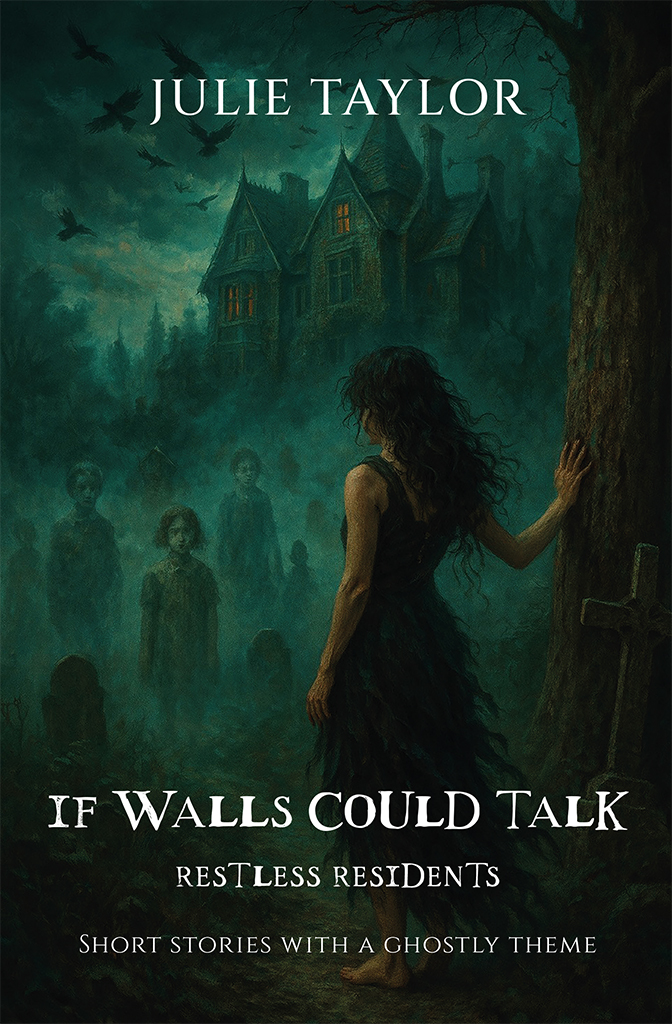
There she stood, tall in stature, stiff lace covering her face, a lady dressed from head to foot in black. In order to display her displeasure, she slowly raised her veil and frowned.
I froze.
~
‘I want to speak to you about the squealing child running around last night.’ A smirk hovered at the corners of her mouth, ‘There are no children on the premises.’
~
Ghosts lurk in the garden, more in the attic. I know – for I have seen them, smelled them, heard them, felt them – the ‘shadow children’.
~
Alice showed them the note then read out the translation. ‘In this house we were always nervous.’ She was mortified, ‘What have I brought us to?’
~
As they stepped onto the pavement, the waiter called out, ‘Keep the lights on. Stay as a group. No one go anywhere alone!’
~
No one could deny what they were seeing. The silhouette of a woman - cast upon the wall. Everyone looked to see whose it might be. There was no one from whom it could have been projected.
~
A hand emerged through the mirror. Its cold bony fingers stroked my face.
Julie Taylor’s first book Is Anybody There? was non-fictional; focusing on haunted locations. This time her creative mind comes to the fore.
Friends; friends of friends, are always eager to share their experiences with her. Even seeking advice when inexplicable things happen to them.
A member of the Clergy requested permission to offer the use of her poems at funeral services, describing them as refreshingly different. She was entrusted to write one for an Italian family. An honour in itself.
This debut collection of fifteen short stories explores whether there is much more to this everyday piece of furniture than it first appears. The chairs in question are all ‘Bentwood’, the innovative creations of the designer Michael Thonet, first introduced in the mid-1830s. As each new character is revealed, and their individual loss becomes apparent, it is evident that chairs are not just for sitting upon and they carry their own history etched within the wood.
One chair becomes a weapon when rival females clash; another a makeshift stage for an older woman, whose decisions have never been her own; a Bentwood rocker is a symbol of independence and choice, and a magnificent butterfly chair befriends a troubled child. In the final story, this assortment of chairs is brought together around one grand table, where Walter, Michael Thonet’s fictitious butler, prepares for a dinner party he will never forget.
Born in Halifax, West Yorkshire, into a family of avid book readers, Jan studied English Literature at Manchester University. She is a compulsive people-watcher and is enthralled by the minutiae of everyday life, utilising both these facets of her personality within her writing.
When not sitting at a desk with pen in hand, she loses herself in the garden, where she can be found with hands in the soil, or inhaling the scent of flowers. You may also catch her walking along country lanes, armed with a camera, or having fun with family and friends.
Reviews of Bentwood...
Bethany Rivers (poet, author and creative writing tutor),
author of ‘Fountain of Creativity: ways to nourish your writing.’
Jan skilfully weaves together the everyday details of the characters’ lives, bringing them vividly to life. She creates a tapestry of stories from a variety of individual character voices you will fall in love with.
When you reach the end of the book, you will want to read these fascinating character portraits all over again.
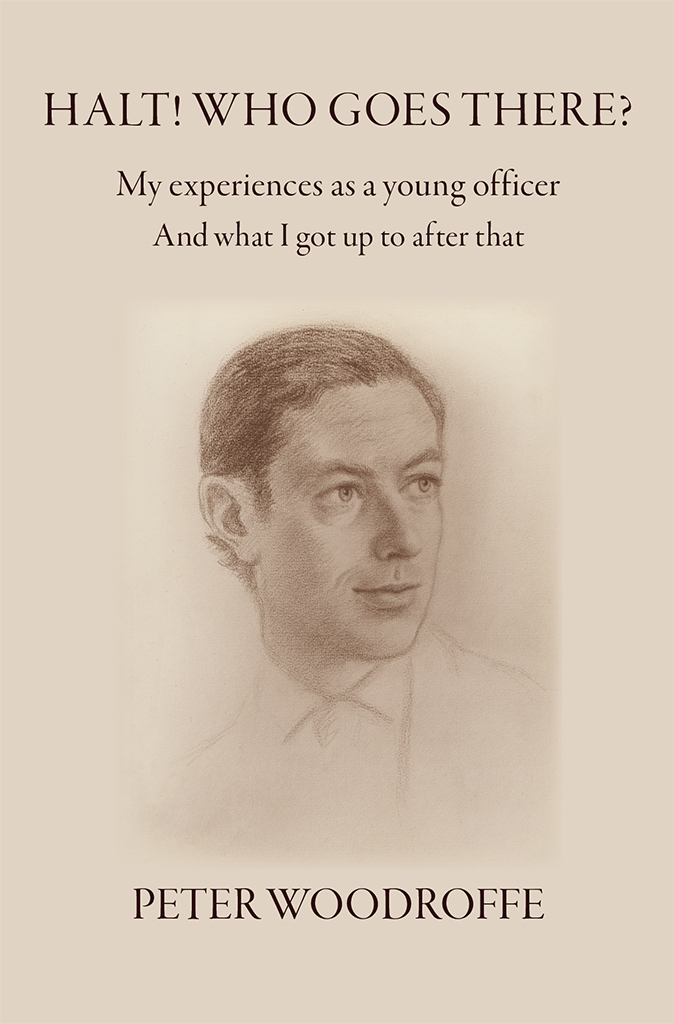
Peter Woodroffe served with the Royal Northumberland Fusiliers 1945-48 in the UK and Gibraltar. He then studied law and became a third-generation solicitor.
In his 95th year he is the oldest practicing solicitor out of the 180,000 odd in England and Wales.
Whilst writing this book, he lived at Cliff End beside the Sussex coast and swam in the English Channel. He plays tennis and golf.
The book spans the period 1945 to 2022.
Having met a multitude of attractive and famous individuals in the armed forces, business and sport, he tells a fund of riveting and at times uproarious stories.
Some of Peter’s many stories include: -
His taking on a bet to steal Robert
Redford’s girlfriend.
Experiencing the thrill and terror
whilst out of control on the Cresta
Run at St. Moritz.
All traffic forbidden inter alia
for Peter, his six year old son and
Chelsea Pensioner to march down
Whitehall.
Tail-gated in his Facel Vega by
Formula One drivers.
His unfair cross examination on
BBC news, repeated eight times in
the day.
Something about houses of ill repute.
Reviews of Halt! WHo Goes There...
General Sir Evelyn Webb-Carter Horcott House, 19 April 2023.
Peter’s reminiscences are indeed amusing and, in some places, hysterical.
There are also some wonderful pearls.
There is something in this book for everybody including stories about bigwig personalities, history, art, clubs, show-biz, cars, historic homes, fine dining and lovely ladies.
One thing is for sure: you won’t be bored.
He has made the acquaintance of many of the great and good (and not so good) and not been shy in commenting on their strengths or weaknesses.
He comes up with little-known, interesting splashes of history.
One of his quests is to give readers advice as to how to live life, like “do not leave behind what you need to take with you”.
When you have produced the final draft of your book, it is always advisable to have the text read and checked by a professional editor or proof reader.
You may have friends that are willing and competent to do this and we can advise you on the type of editing that is required.
We can offer four levels of editing as well as proof-reading.
You choose which, if any, are appropriate in your case: 1. Edit of sample pages and short report (£30)
We will edit a few pages to highlight editorial issues so that you can look for similar problems throughout the book.
This will reduce the amount of further copy-editing required when the book is finished. 2. Broad structural editing and criticism (£5 per thousand words)
A structural review is particularly relevant for works of fiction.
The structural reviewer will address the following main areas and produce a short report for the author ” Read More 3. Copy editing (£10 per thousand words)
A copy-editor takes a close look at your text, line by line, with an eye to grammatical errors, repetition, inconsistency and lack of clarity. The copy editor will make changes to the text, with suggestions for rewriting, grammar, and punctuation. When you receive the edited version, you have the final choice about accepting of rejecting the individual changes. 4. Proof Reading (£8 per thousand words)
Proof reading is a line-by-line check that the book is ready for publication. Proof readers will make small corrections for punctuation, grammar and spelling but they will not make significant changes to the text.
A proof reader will identify any significant issues and add comments to the text so that you can make those corrections yourself. 5. Consistency Scan
If you decide your book doesn’t need a full proof reading, we offer an electronic scan to search for common errors and inconsistencies. This looks at issues such as inconsistent spelling and inconsistencies of hyphenation and capitalisation.
We can also identify inconsistencies in the spelling of proper names. 6. Cover text
The quality of the text on the cover is very important as it indicates the quality of the writing in the book.
The title, sub-title and back-cover blurb are all important elements and we can work with you to make sure that these are correct and effective.
Copy Edit
Copy-editors get the raw material into shape for publication i.e they edit the copy.
When they have finished, the designer can lay out or typeset the book and produce a proof.
It is quite normal for the author to make additional changes after a book has been copy-edited.
Working through the material, the copy-editor may identify errors in spelling, punctuation, grammar, style and usage, but also very long sentences and overuse of italic, bold, capitals and exclamation marks.
They should correct or query doubtful facts, weak arguments, plot holes and gaps in numbering.
In fiction, they should also check that characters haven’t changed their name or hair colour, look for sudden changes from first to third person among other things.
The Copy-editor is not a proof reader and should not be expected to find all of the errors in the text particularly if the text is badly written to start with.
This is the job of the proof reader.
The final proof should be checked by a proof reader or an experienced reader friend before going to print.
It is almost inevitable (and acceptable) to miss a few errors which can be corrected in a later edition.
Proof Reading
Proof reading is a line-by-line check that the book is ready for publication.
Proof readers will make small corrections for punctuation, grammar and spelling but they will not make significant changes to the text.
A proof reader will identify any significant issues and add comments to the text so that you can make those corrections yourself.
If you have decided to complete this stage of the process yourself, we will send a detailed check-list to help you.
We ask you to try and ensure that the book is completely ready before we start the layout.
Once the layout has started, we expect that you might want to to make a small number of amendments but
if there are a significant number, we may need to charge for the extra time it takes to change the layout
so best to discuss this with us first.
Structural Review
In fiction, the main areas that a structural editor will address are:
Plot: Does the plot make sense? Is it believable? Is it satisfying or does it leave the reader frustrated? Themes: Are the themes effectively handled? Are there so many that the book lacks focus? Do they interfere with the plot or complement it?
Characterisation: Are your characters well developed and believable? Are they cast in a role that fits their personality? Do they sometimes behave out of character? Point of view/voice: Is the voice consistent or is it sometimes confused? Is the voice authentic? Are you using too many or too few POVs? Pace: Does the plot move forward at an appropriate pace? Should you cut that preface? Should the action happen sooner or should the tension build more slowly? Dialogue: Do your characters sound real when they speak? Is your dialogue cluttered with adverbs and beats? Do you use clunky dialogue to move the plot forward? Flow: Is the narrative interrupted by dead-ends and tangents? Is there so much back story that the main plot is dwarfed? Are there missing plot points that would give the narrative greater integrity?
In non-fiction, the principle is the same, but the specific issues are slightly different:
Thesis: Is your thesis relevant? Is it clearly defined or is it lost among marginal issues? Exposition: Are your arguments clear and cogent? Are they well researched and properly supported? Do they have a clear relationship with your thesis? Content: Are all the necessary topics sufficiently dealt with? Are the chapters weighted correctly? Is there superfluous content? Organisation: Is the information organised logically? Are tables and illustrations used appropriately? How many levels of subheads do you need and how should they be arranged? Tone: Is the tone appropriate for the audience? Do you need to eliminate jargon? Is the text accessible? Pace: Are there passages that are bogged down in detail? Do you spend too long on detail irrelevant to the main thesis? Are there areas that need further exposition lest they be skipped over?
Cover Text
The quality of the text on the cover is very important as it indicates the quality of the writing in the book.
The title, sub-title and back-cover blurb are all important elements and we work with you to make sure that these are as effective as possible.
Consistency check
If you decide your book doesn’t need a full proof reading, we can run an electronic scan to search for common errors and inconsistencies.
This looks at issues such as inconsistent spelling, hyphenation and capitalisation.
It also checks for consistent formatting of numbers and dates as well as undefined abbreviations.
Full Script Edit
The script that you deliver to us will probably constitute what the industry would classify as the ‘Initial Rough Draft’, i.e. a full screenplay written without any other professional input or advice, and probably without a great deal of rewriting. We work through your draft, line by line, scene by scene, and come back to you with a comprehensive set of notes from which you can then work towards the official ‘1st Draft’. Some of our notes will be broad and general, dealing with such areas as the overall shape and structure, pacing, plot and character development; others will be far more specific, with corrections, clarifications and suggested cuts etc. It is of course entirely up to you whether or not to take these suggestions on board, and to what extent.
Subsequent Script Edit
It is very normal and generally beneficial for the script-editing process to go through at least a couple of cycles
i.e. the rewritten draft to be worked through once again by an experienced script practitioner – though this would be entirely at the discretion and behest of the writer.
Ongoing Support
We aim to make your self-publishing venture an enjoyable and rewarding experience.
Publishing is a complex business and we treat every book as a separate project.
We explain all of the stages at the outset and we manage the project schedule for you. This will include all of the expert services you have requested for editorial, design, printing, distribution and collection of royalties, keeping in close contact with you throughout the process.
You will be allocated a project-sheet on the YouCaxton website so that you can monitor progress and ensure that all stages are properly completed.
If you would like to see an example of a Project-Sheet…
go to My project on the menu and enter…
Username: Sample
Password : welcome.