|
|
Available from Amazon |
||||||||
|
|
||||||||||
A Purely Agricultural Parish
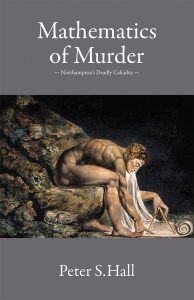
A distinguished mathematician is sent to Northampton to solve a murder
Peter Hall
|
|
Available from YouCaxton £12.50 (+ £2 postage) Available from Amazon |
||||||||
|
|
||||||||||
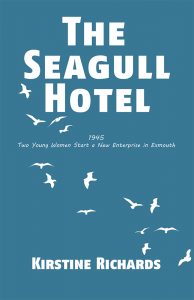
1945, Two young women start a new enterprise in Exmouth
Kirstine Richards
|
|
Available from YouCaxton £10.00 (+ £2 postage) Available from Amazon |
||||||||
|
|
||||||||||
Review by Richard Moss
The Seagull Hotel offers a fascinating, moving and heart-warming first hand account of the struggles of two young mothers widowed during World War II. Told with candour and humour we hear about the conditions at the time and about the characters who worked at the hotel, and those who were guests. How would you turn a semi-derelict building into a thriving business when just getting hold of linen, furniture and food needed a special sort of daring and guile?
Review by Jane Dunbar
A truly inspiring book. A story of perseverance in the face of amazing difficulties., in which the author manages to infuse one disaster after another with humour.
Oh how I enjoyed it.
Amazon review by Mrs Rivers
I have just romped through The Seagull Hotel in 3 sittings- I loved it!
What a very special woman Kirstine was, so full of determination, courage and enthusiasm, undaunted, it seems by anything. Reading her story, she emerges as a precursor to 60’s feminism; widowed towards the end of WW2, mother of two small children with virtually no money, she navigates a path through what was then very much a man’s world of bankers and builders, discovering en route the thrills and spills of the black market in order to beat the post-war rationing system. With her friend Gerdy, also a young widow with children, she battles to establish The Seagull Hotel not just as a viable business but also as a loving home for the two families. What could have been just another drab seaside hotel on the English coast develops into a truly creative enterprise and becomes widely known for its excellent gourmet food. This splendid book is a hymn and testament to these two young women who refused to let misfortune, or men, get the better of them but don’t get the idea that it is in any way heavy going or gloomy. It is written with a lightness of touch, masses of humour - I laughed till I cried over the chapter about her mother - and, above all, humanity.
Amazon review by nettiek50
This is a beautifully written memoir
About two young widows struggling in a male dominated post war era.
A very easy and enlightening read. Parts of Exmouth remain the same to this day.
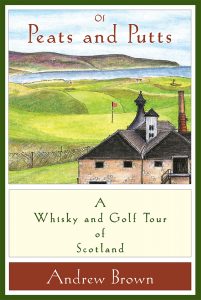
Of Peats and Putts – A whisky and golf tour of Scotland
Andrew Brown
|
In this book, one man returns to rediscover his native Scotland through its most famous exports; whisky and golf. He finds that both derive from what makes Scotland great – its land and its people – and that the very earth contributes to the essential ‘architecture’ of both. With an engaging and philosophical approach, the author creates a tour of Scotland, offering insight into the industries behind whisky and golf, as well as the history and experience of both. Matching distilleries and courses by region, he discovers some hidden gems and some unique experiences, concluding that both pursuits offer more than the sum of their parts. Both simple yet complicated, these two great representatives of Scotland offer insight into this unique country, its landscape, its people and beyond that life itself. |
UK Only Available from Amazon | ||||||||
|
Andrew Brown was born in Edinburgh, brought up in the Borders and educated at Loretto School in Musselburgh. After reading history at Cambridge University, he pursued a career in the food industry, marketing many famous brands such as Bisto, Hovis and Mr Kipling. He has three grown-up children, is now retired and, outside of his regular visits to Scotland, lives in the Chilterns. Apart from playing golf he is an enthusiastic dog walker, a very average tennis player and a novice gardener. |
||||||||||
|
Reviews... Charles Maclean, Whisky Writer and Master of the Quaich It is astonishing that until now nobody has sought to bring together Scotland’s two greatest gifts to the world – whisky and golf. This little book is a personal journey of discovery. In ten chapters, each devoted to a region or county – from Sutherland in the north to East Lothian in the south and Islay in the West - Andrew Brown reviews a golf course and a locally made malt whisky. As he travels from one place to the next he ponders how and why these two products developed in Scotland and what it is about the country, its landscape and people, which connects them. As he writes: “Both whisky and golf are more than just a drink and a sport; both can be seen as metaphors for the vagaries of life itself.” Indeed! Golf Quarterly Review June 2018 This is a delightful, well-written little book – part travel guide, part history, part personal philosophy, and part unwitting nationalist tract (what better way, after all, to celebrate Scottish distinctiveness than through writing about its two most famous exports?). It takes the form of a tour of nine regions of the country, in search of the author’s favourite distilleries and favourite golf courses along the way. I can imagine peripatetic golfers with a fondness for an evening dram, or whisky aficionados with a set of clubs in the boot of their car, packing this little volume and reading up on pleasures planned for the following day. It will be equally enjoyable, though, with a glass of single malt to hand in the privacy of your own home. What gives the journey special significance is the author’s playful exploration of the similarities and connections between whisky and golf. Andrew Brown, a native Scot who spent most of his career in the food industry south of the border, suggests that location, history and architecture are crucial to the two experiences. History, for instance, is an important part of the narrative that accompanies both playing and drinking. Just as we like to know the origins, ownership and social impact of a particular whisky brand (notwithstanding the marketing hype), so hearing about how and when a golf club was founded, who played there and who designed and changed it invariably enriches a round of golf. Perhaps design is the most striking common factor given the simple, limited and seemingly unpromising ingredients that course architects and whisky manufacturers both start with. All golf courses are hewn out of sand and soil, while the essential elements of any whisky are also the same: only malted barley, water and yeast are permitted in anything that calls itself Scotch. What produces so many different and unique variations of the spirit is everything from the distilling process to the local landscape, whether it be the taste of the water, the quality of the soil, or the extent of the annual rainfall. In the case of golf it’s the eye and skill to use nature to best effect. Each chapter describes the idiosyncrasies of a favourite course and distillery. The golf choices are far from predictable – Brora rather than Dornoch in Sutherland, Kilspindie rather than Gullane, Luffness New or Muirfield in East Lothian, the Eden rather than the Old Course in Fife. These reflect not just a conscious decision to stay away from Championship venues but those the author considers best meet his three criteria for selection: a tough but enjoyable (and affordable) test for all levels of golfer, delightful surroundings and a welcoming clubhouse. There is an equally diverse spread of distilleries, old and new, large and small, ranging from multinational owned enterprises such as Glenmorangie to independent Edradour in Perthshire (20,000 cases of which went down off the island of Eriskay in 1941, inspiring Compton Mackenzie’s wonderful book Whisky Galore). Wisely, the author does not take prior knowledge for granted though spelling out a three-shotter for golfers or mash tuns for devoted whisky drinkers may mildly irritate some. I liked his many diversions - musings on what makes a good golf hole and a good malt, for example, thumbnail sketches of important golf designers like James Braid and Harry Colt, and reflections on the history and practise of naming golf holes. There are plenty of surprises (at least to this non-expert whisky drinker). Did you know that eight of the world’s top ten whisky brands are Indian, while the country that consumes the most whisky on a per capital basis is France (the United States being second and the UK third)? Tim Dickson Editor Golf Quarterly Simon Marquis, Cornwall Of Peats and Putts will appeal to anyone who enjoys golf and/or malt whisky. Andrew Brown is an enthusiastic amateur of both and his enjoyment shines through this delightful scamper across nine of Scotland’s finest golf holes, and a rather more leisurely trundle around nine of its distilleries. The real pleasure of this short volume though is the author’s drawing of nice parallels between these twin pleasures and life itself. Golf has its ups and downs as do our lives, some of them at least, perhaps smoothed away by a late evening dram or two! The book is a pleasure in itself. I eagerly await volume two. |
Nazeing History Workshop, Essex
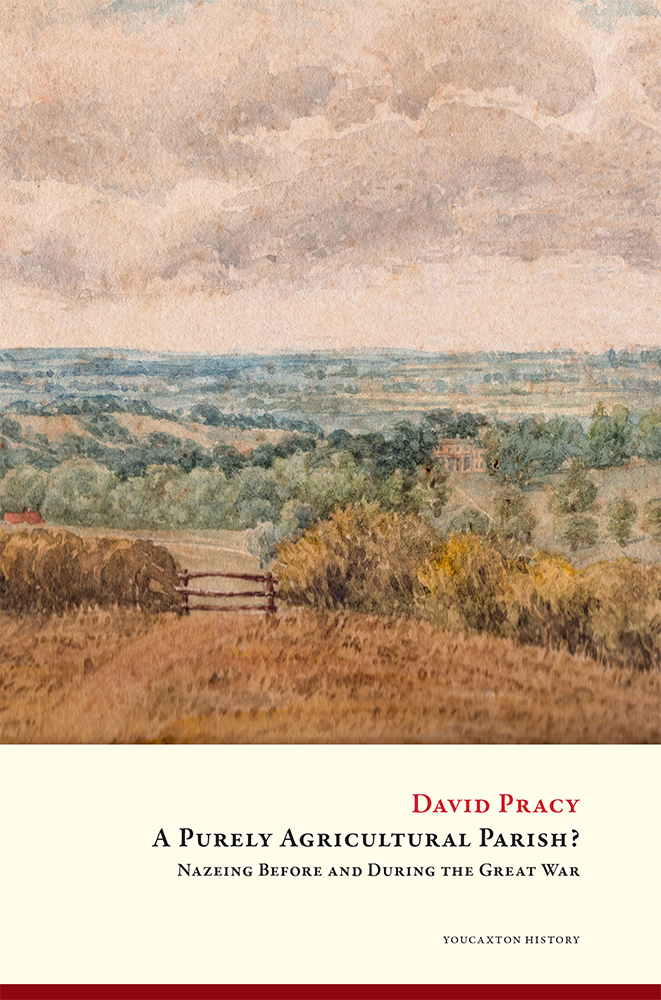
David Pracy’s minutely researched new book, A Purely Agricultural Parish? Nazeing before and during the Great War, published by YouCaxton and part of our History Series, is being launched at an exhibition by the Nazeing History Workshop, 5-7 May, at St. Giles Hall, Nazeing Road, Essex, EN9 2HU. Admission is free and there is a special offer on titles previously published by Nazeing History Workshop.
A Purely Agricultural Parish? contains a wealth of detailed information about Nazeing families of all classes immediately before and during World War I and is enlivened by 180 illustrations. It is a very effective account of the social make-up of Nazeing at that time. It will be on sale at £10.00.
Margaret Clive and Friends
At 7.30 pm on Thursday 17th May, in Bishop’s Castle Town Hall, YouCaxton Managing Editor Bob Fowke will be repeating his talk, ‘Margaret Clive and Friends’, interest from the public having exceeded the available space in February.
During the eighteenth century some remarkable young women crossed the ocean to India to seek their fortunes. Margaret Maskelyne who married Clive of India and was sister to Nevill Maskelyne, Astronomer Royal, was one of the cleverest – and funniest. Bob Fowke will be exploring her life and the network of her friends, in a talk relating to his upcoming book.
‘Women were an essential element within the Company from its earliest days. The gravestones and memorials around Saint Mary’s Church in Fort St George, Chennai/Madras, bear ample testimony; around a quarter of them are of women, several dying early in childbirth. But those tragic deaths tell only part of the story. It took courage, ambition and a spirit of adventure to travel to the far side of the world in search of love and fortune and the young women who undertook that journey were exceptional people, setting out of their own accord, sometimes with only the grudging consent of parents or guardians, and confidently accepting the risks. Many of them traded independently and some were of high intellect …’
Not to be Forgotton
Cynthia Bryan

|
|
For UK orders only
For non-UK orders,£10.00 - (plus £2.00 postage) Number of copies: please send an email to Enquiries@youcaxton.co.uk Available soon on Amazon |
||||||
|
| ||||||||
Ian Flintoff
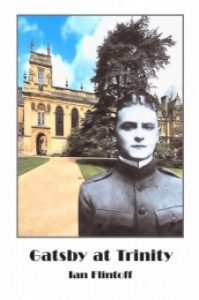
An excellent review in the Oxford Times, 18 January 2018 by Christopher Gray of Ian Flintoff’s novel, Gatsby at Trinity, production and distribution by YouCaxton Publications:
‘THE television showing over Christmas of the excellent 2013 film version of Scott Fitzgerald’s The Great Gatsby with Leonardo DiCaprio (and an even better Tobey Maguire) prompted me to take out a book that had languished some months in my ‘waiting to read’ pile. This was Gatsby at Trinity (Pitchfork Production, £9.99) by the Oxford-based actor, writer and director Ian Flintoff – and what a delight it proved. Impeccably researched and elegantly written, the novel traces the mysterious millionaire’s formative years, after First World War service in the US army, as an undergraduate at Oxford University. His student days are, of course, alluded to in The Great Gatsby, though it is never entirely clear whether they were pure invention. Gatsby certainly convinced the sinister character Meyer Wolfsheim. Who can forget his observation: “He’s an Oggsford man. He went to Oggsford College in England. You know Oggsford College?” The college in fact was Trinity, alma mater to Ian Flintoff too. Tom Buchanan, supercilious about Gatsby’s claim in The Great Gatsby, is shown a photograph of Jay in Trinity Quad – “the man on my left is now the Earl of Doncaster”. We get to meet the aristocrat as Lord Cusworth, one of Gatsby’s college companions, in Gatsby at Trinity. It turns out that it was his expression “old sport” that came to be borrowed by Gatsby. “Where’d you pick that up?” Tom asked him in The Great Gatsby, but answer came there none.
In the prequel we learn from Lord Cusworth that he employs the device as a means of disguising the fact that he has forgotten someone’s name. “Nobody’s offended and the old memory gets a decent break for a change.” Highlights of the novel (and Gatsby’s Oxford social life) include a ball at Blenheim where guests include Bernard Shaw, Noel Coward and Edward Elgar.
Great stuff.’