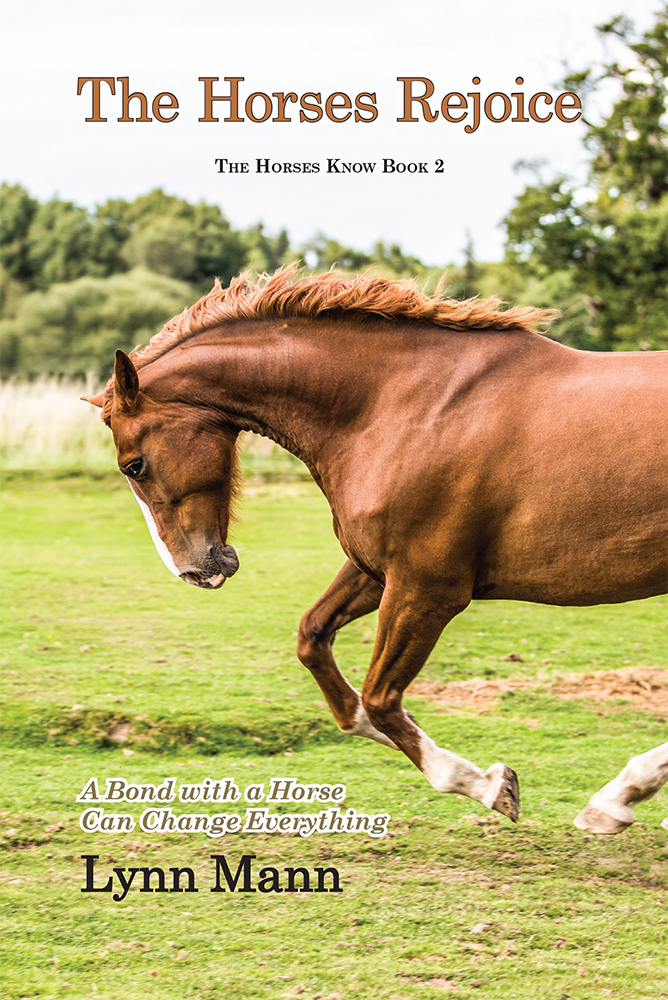
Amarilla and Infinity have been the catalysts for change that they agreed to be, but they know there is more to be done. If they can befriend the Woeful and persuade the rest of humankind to do the same, then the ways of The Old will forever be in the past.
Amarilla, Infinity and their friends set out on a journey to find the Woeful, only to discover that their search becomes something so much more due to the horses they meet along the way. But they never forget what they agreed to do. They must find the Woeful. And then they must be willing to risk losing everything.
Lynn Mann is a writer with a long-standing involvement with horses. During her school years, she spent as much time riding and being with horses as she could. She took a break from horses to study for her biology degree and then on leaving university, realised her dream of having her own horse for the first time. She worked on show-jumping, racing and dressage yards before starting a business as a saddle consultant and riding instructor, which involved working both in the UK and abroad.
Carrie - 5 star review I absolutely love this book. It is a worthy sequel to the brilliant The Horses Know, and I have reread this book no less than three times so far. I get something more from it every time I read. Yes, it is a novel set in a fantasy future and is a wonderful compelling story, but the ideas behind the book are no less real for that. Get talking to your horses, listen to what they have to say - anyone can do this, truly. This book will show you the way, inspire you, and change the way you interact with your horses forever. Let Amarilla, Infinity and the Kindred open your heart and your mind. It is an incredible book and worthy of its' current no.1 position on Amazon in the Equine books section. I cannot wait for Book 3 . . . .
T Stretton - 5 star review
It is not often I feel inspired by works of fiction, but both this book and 'The Horses Know' have certainly changed the way I view the world. Aside from that, the easy style in which it is written and careful storytelling have kept me glued to the pages, day after day, just as a good book should! I am actually rather sad that this story is over! As with the first book, this is most definitely not just for 'horsey' people; such an interesting idea needs to be shared!
Tracy - 5 star review If you enjoyed The Horses Know then you will certainly enjoy The Horses Rejoice. Lynn Mann has a talent that is unique, her books will grab your attention and not let go until you've read the whole book so make sure you have lots of spare time. The Horses Rejoice continues the story but with its own individuality, I just hope Lynn is preparing to write the next book. Every horse lover or even those who like a good read should have these books in there possession.
Beki - 5 star review
Such an amazing book! I loved the first one (The Horses Know) and this was a fantastic continuation of the story. If you have horses you need to read these books - there are some wonderful insights and they have helped me immensely. Please write more Lynn!
Emma Magliocco - 5 star review
Highly recommend excellent read could not put it down anyone who has horses would love this book as I did.
Kindle Customer - 5 star review
I wasn't sure if this would be my kind of book but I absolutely loved it.
It's well written and such a clever idea. I found myself relating things to experiences with my own horse and I feel more connected to him now.
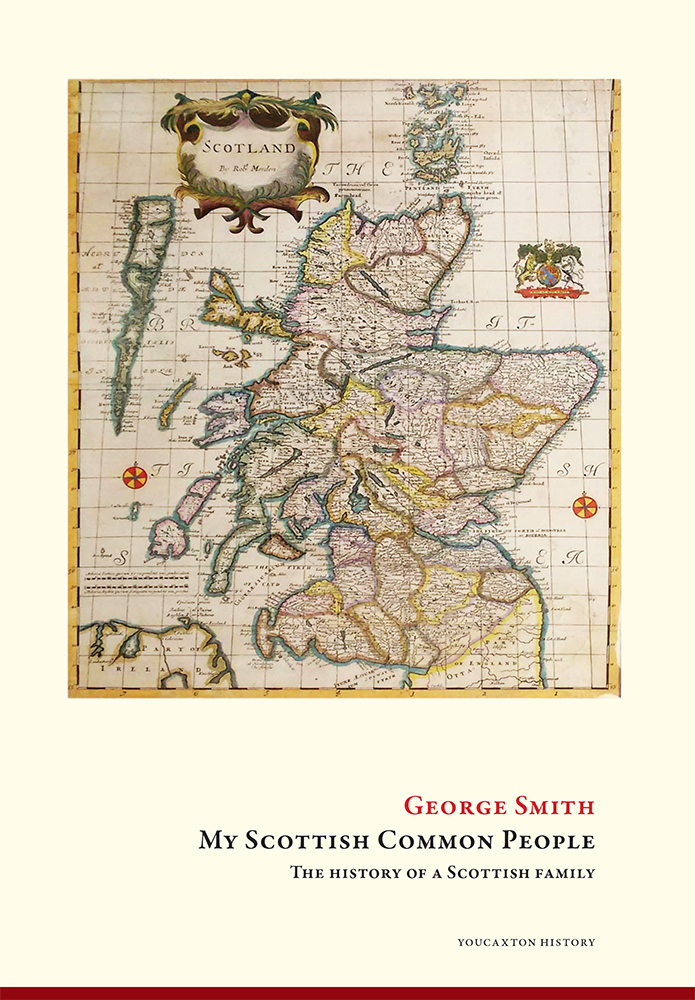
My Scottish Common People is the account of a family history which could stand for a history of the Scottish working class over the last four hundred years. George Smith has tracked eight paternal and maternal lines of forebears, common people who lived in Angus, Inverness-shire, Perthshire, Fifeshire, Orkney and Dundee. They include jute mechanics, seamstresses, handloom weavers, smallholders, farm hands, and fishing families, and finally the not-so-common author’s father, a shipyard joiner who became a trade union leader, TUC president and knight of the realm who will be familiar to many in the Labour Movement.
This book tells of the life events of ordinary people and their pursuit of livelihoods. Included are: members of a congregation that quit the Church of Scotland over a point of principle in 1733, a thirteen-year-old fisherman who joined the naval militia during the Napoleonic war, a politically active shoe clicker who supported a Proletarian Sunday School, a stone mason who helped to build Stevenson lighthouses, an Orkney ploughman and family who migrated to Dundee for a better life, a poor agricultural labourer given free oatmeal and cash from the the Church of Scotland, a widowed mother who survived as a seamstress. All are representative, including, and perhaps especially, a handloom weaver, later soldier, who was in a mutiny in 1794.
George Smith was born in Dundee and moved to England as a child. He has since visited Scotland many times. He was educated at Nottingham University, Garnett College, the London School of Economics and the Institute of Education, London University which awarded him a doctorate. For most of his working life he was a lecturer in social studies and contributed to academic publications. He was a magistrate for nine years. In retirement he has furthered his long-held interest in family history through research and published articles. A volunteer, he is an adviser for Citizens Advice. He lives in Worcestershire.
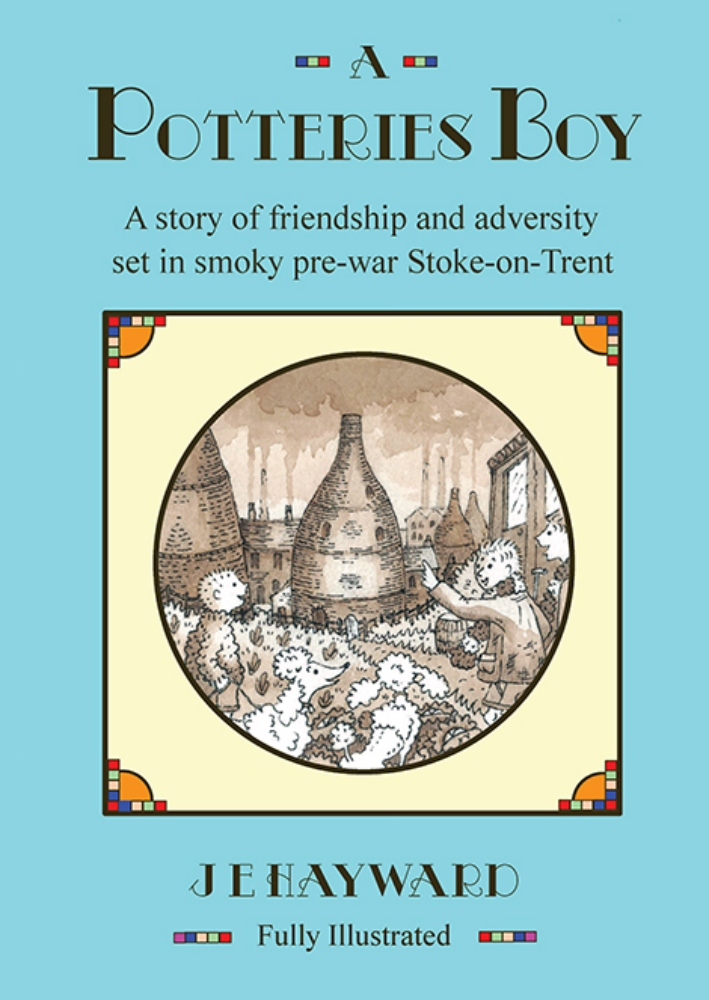
Set between the wars and touched by both of them, this is a story about the transformative power of creativity… and the jealousy that it can arouse.
Whilst being true to the spirit of her late father, the Royal Doulton Art Director and designer Walter Hayward, the author has spun an exciting tale of loss and restoration, friendship and bullying, in which a close-knit community comes together to help Walter achieve his dream of creating a great Dragon Vase… with surprising results!
And not everyone is friendly… The lamplit streets and smoky bottle ovens harbour an evil presence.
This is a cosy story – with a dark edge.
Jean Hayward was born, grew up, and worked in the Potteries before leaving for university and a career as an English Lecturer in the English Midlands. Jean is now retired and writes and illustrates nostalgic novels inspired by her hometown and by her father, Walter Hayward, whose fictional childhood adventures form the basis for themes dealing with love and loss, the supernatural, transformation, restoration, and the triumph of kindness and love over frailty or even downright evil. Jean has a horse, a Shetland pony and a cat and enjoys bringing animals and humour into her writing.
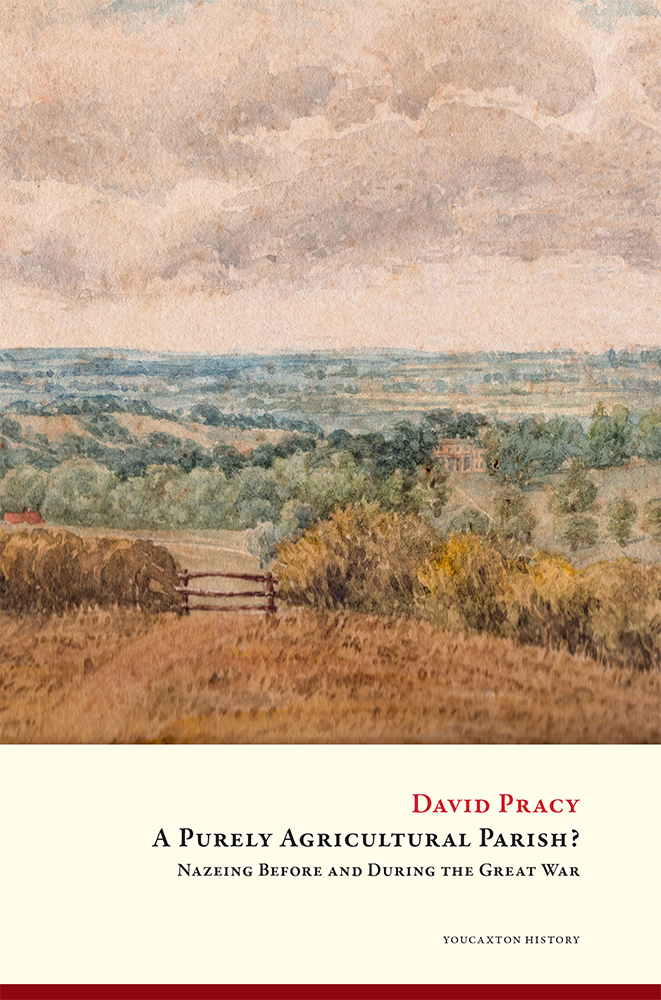
This book paints a vivid picture of a west Essex country village in the nineteenth and early twentieth centuries. In 1900 and again in 1912, Nazeing Parish Council described it as ‘a purely agricultural parish’, and the book asks how true this statement was. Almost half of Nazeing people were born in the village, and almost half of those who worked had jobs related to the land. Yet in 1908 a new housing development and the building of an important new road began the changes that were to transform Nazeing in the twentieth century.
A wide range of sources includes censuses, the Lloyd George land survey of 1909-12, trade directories, newspapers, and reminiscences of older people who were children in Nazeing before the Great War. There are short biographies of the thirty-three men who died in that war and the names of the 155 who served. Over a hundred buildings are described, most of them accompanied by photographs, and there is an unusual and refreshing emphasis on ‘ordinary’ working families.
The book will interest anyone who lives or has family roots in Nazeing, and also the general reader and the specialist historian.
Nazeing History Workshop was founded in 1993 to discover, record and share the long and rich history of this west Essex village.
David Pracy is a retired librarian who has an MA in Local and Regional Studies from the University of Essex.
Jacky Cooper is a retired therapist whose family roots in Nazeing go back 200 years.
The cover images were painted by Kate Henty, who lived in Nazeing from 1872 to 1886.
Nazeing History Workshop was founded in 1993 to discover, record and share the long and rich history of this west Essex village.
David Pracy is a retired librarian who has an MA in Local and Regional Studies from the University of Essex.
Jacky Cooper is a retired therapist whose family roots in Nazeing go back 200 years.
The cover images were painted by Kate Henty, who lived in Nazeing from 1872 to 1886.
It is the middle of the nineteenth century. Brothers William and Robert Crossley both seek refuge from the severe discipline of their father in their very different dreams. William wishes to stay in their hometown of Northampton and follow his uncle as the town’s best watch and clock maker. Robert longs to get away and become famous. William defies his father and refuses to take the Cambridge entrance examination. Robert finds a tutor in the Vicar of Upstone, who not only prepares him for the examination, but also leads him in the creation of a seminal mathematical theorem. Robert finds fame and fortune through the work.
But Robert’s authorship of the theorem is questioned. The President of the Royal Society sends Edward Pennington, a distinguished mathematician, and Doctor Clara Cox, to investigate. They uncover secrets that not only change themselves, but also have unforeseen consequences for the whole Crossley family.
Two young, recently widowed mothers try to find a way to survive in war-scarred Britain. Kirstine and her German friend, Gerdy, lost their husbands at the end of the Second World War. They find themselves penniless, without any extended family support, each with two very young children and with scant prospects of earning a living.
A great deal of determined initiative is needed. The stakes are high with chaos threatening them at every step. The two women find a de-requisitioned building in seaside Devon. They transform it into a family hotel, which eventually becomes renowned for its excellent cuisine.
This enchanting story, told with a lightness of touch, moves from tragedy, to comedy, to triumph and back again.
Kirstine Richards née Rasmussen was born in Edinburgh to a Danish father, Christian Rasmussen, and Hilda Hill-Jones, on 14th March 1912, whose mother was Mary Ann McNair.
She attended Edinburgh School of Art for one year, until her father died and the fees could no longer be paid. Life with her eccentric mother became intolerable. Fortunately an aunt came to the rescue and Kirstine moved to Devon, where she worked as a poorly paid designer at the Honiton Pottery.
Subsequently Kirstine opened a café on Honiton High Street, called the ‘Highland Fling’ and it served excellent coffee and homemade cakes; making it very popular. She met her future husband, Gerald Arthur Richards; a young medical student from St. Bartholomew’s Hospital, at the ‘Highland Fling’.
Their two children, Nicholas and Louanne, were born during the 2nd World War and their father, Gerry, was accidentally wounded in Burma and died at Imphal on the 23rd January 1945.
Kirstine, now a widow with two young children, had to find a way of earning a living. She and Gerdy Ramsay, who was also a widow and mother of two, together established a family hotel; ‘The Seagull’ in Exmouth in South Devon. The hotel opened in 1945.
In 1959 Kirstine moved on from being a hotelier to becoming the case worker at the newly formed Agnostic Adoption Society, which was later to become the Independent Adoption Society.
On retirement, she went to live near her cousin in the South of France, where she rented a small house; paying for her keep by hosting summer guests. A secondary breast cancer made her decide to move back to England, where she found an apartment at Queen Alexandra’s Court in Wimbledon; an attractive establishment for the widows of officers who had served in the forces.
Kirstine died at St. Raphael’s hospice in London on the 25th February 1989.
Reader Reviews...
Review by Richard Moss The Seagull Hotel offers a fascinating, moving and heart-warming first hand account of the struggles of two young mothers widowed during World War II. Told with candour and humour we hear about the conditions at the time and about the characters who worked at the hotel, and those who were guests. How would you turn a semi-derelict building into a thriving business when just getting hold of linen, furniture and food needed a special sort of daring and guile?
Review by Jane Dunbar
A truly inspiring book. A story of perseverance in the face of amazing difficulties., in which the author manages to infuse one disaster after another with humour.
Oh how I enjoyed it.
Amazon review by Mrs Rivers
I have just romped through The Seagull Hotel in 3 sittings- I loved it!
What a very special woman Kirstine was, so full of determination, courage and enthusiasm, undaunted, it seems by anything.
Reading her story, she emerges as a precursor to 60’s feminism; widowed towards the end of WW2, mother of two small children with virtually no money, she navigates a path through what was then very much a man’s world of bankers and builders, discovering en route the thrills and spills of the black market in order to beat the post-war rationing system. With her friend Gerdy, also a young widow with children, she battles to establish The Seagull Hotel not just as a viable business but also as a loving home for the two families. What could have been just another drab seaside hotel on the English coast develops into a truly creative enterprise and becomes widely known for its excellent gourmet food.
This splendid book is a hymn and testament to these two young women who refused to let misfortune, or men, get the better of them but don’t get the idea that it is in any way heavy going or gloomy. It is written with a lightness of touch, masses of humour - I laughed till I cried over the chapter about her mother - and, above all, humanity.
Amazon review by nettiek50
This is a beautifully written memoir
About two young widows struggling in a male dominated post war era.
A very easy and enlightening read. Parts of Exmouth remain the same to this day.
In this book, one man returns to rediscover his native Scotland through its most famous exports; whisky and golf. He finds that both derive from what makes Scotland great – its land and its people – and that the very earth contributes to the essential ‘architecture’ of both.
With an engaging and philosophical approach, the author creates a tour of Scotland, offering insight into the industries behind whisky and golf, as well as the history and experience of both.
Matching distilleries and courses by region, he discovers some hidden gems and some unique experiences, concluding that both pursuits offer more than the sum of their parts. Both simple yet complicated, these two great representatives of Scotland offer insight into this unique country, its landscape, its people and beyond that life itself.
Andrew Brown was born in Edinburgh, brought up in the Borders and educated at Loretto School in Musselburgh. After reading history at Cambridge University, he pursued a career in the food industry, marketing many famous brands such as Bisto, Hovis and Mr Kipling. He has three grown-up children, is now retired and, outside of his regular visits to Scotland, lives in the Chilterns. Apart from playing golf he is an enthusiastic dog walker, a very average tennis player and a novice gardener.
Reviews...
Charles Maclean, Whisky Writer and Master of the Quaich
It is astonishing that until now nobody has sought to bring together Scotland’s two greatest gifts to the world – whisky and golf.
This little book is a personal journey of discovery. In ten chapters, each devoted to a region or county – from Sutherland in the north to East Lothian in the south and Islay in the West - Andrew Brown reviews a golf course and a locally made malt whisky.
As he travels from one place to the next he ponders how and why these two products developed in Scotland and what it is about the country, its landscape and people, which connects them. As he writes: “Both whisky and golf are more than just a drink and a sport; both can be seen as metaphors for the vagaries of life itself.” Indeed!
Golf Quarterly Review June 2018
This is a delightful, well-written little book – part travel guide, part history, part personal philosophy, and part unwitting nationalist tract (what better way, after all, to celebrate Scottish distinctiveness than through writing about its two most famous exports?). It takes the form of a tour of nine regions of the country, in search of the author’s favourite distilleries and favourite golf courses along the way.
I can imagine peripatetic golfers with a fondness for an evening dram, or whisky aficionados with a set of clubs in the boot of their car, packing this little volume and reading up on pleasures planned for the following day. It will be equally enjoyable, though, with a glass of single malt to hand in the privacy of your own home.
What gives the journey special significance is the author’s playful exploration of the similarities and connections between whisky and golf. Andrew Brown, a native Scot who spent most of his career in the food industry south of the border, suggests that location, history and architecture are crucial to the two experiences. History, for instance, is an important part of the narrative that accompanies both playing and drinking. Just as we like to know the origins, ownership and social impact of a particular whisky brand (notwithstanding the marketing hype), so hearing about how and when a golf club was founded, who played there and who designed and changed it invariably enriches a round of golf.
Perhaps design is the most striking common factor given the simple, limited and seemingly unpromising ingredients that course architects and whisky manufacturers both start with. All golf courses are hewn out of sand and soil, while the essential elements of any whisky are also the same: only malted barley, water and yeast are permitted in anything that calls itself Scotch. What produces so many different and unique variations of the spirit is everything from the distilling process to the local landscape, whether it be the taste of the water, the quality of the soil, or the extent of the annual rainfall. In the case of golf it’s the eye and skill to use nature to best effect.
Each chapter describes the idiosyncrasies of a favourite course and distillery. The golf choices are far from predictable – Brora rather than Dornoch in Sutherland, Kilspindie rather than Gullane, Luffness New or Muirfield in East Lothian, the Eden rather than the Old Course in Fife. These reflect not just a conscious decision to stay away from Championship venues but those the author considers best meet his three criteria for selection: a tough but enjoyable (and affordable) test for all levels of golfer, delightful surroundings and a welcoming clubhouse.
There is an equally diverse spread of distilleries, old and new, large and small, ranging from multinational owned enterprises such as Glenmorangie to independent Edradour in Perthshire (20,000 cases of which went down off the island of Eriskay in 1941, inspiring Compton Mackenzie’s wonderful book Whisky Galore).
Wisely, the author does not take prior knowledge for granted though spelling out a three-shotter for golfers or mash tuns for devoted whisky drinkers may mildly irritate some. I liked his many diversions - musings on what makes a good golf hole and a good malt, for example, thumbnail sketches of important golf designers like James Braid and Harry Colt, and reflections on the history and practise of naming golf holes. There are plenty of surprises (at least to this non-expert whisky drinker). Did you know that eight of the world’s top ten whisky brands are Indian, while the country that consumes the most whisky on a per capital basis is France (the United States being second and the UK third)?
Tim Dickson
Editor
Golf Quarterly
Simon Marquis, Cornwall
Of Peats and Putts will appeal to anyone who enjoys golf and/or malt whisky. Andrew Brown is an enthusiastic amateur of both and his enjoyment shines through this delightful scamper across nine of Scotland’s finest golf holes, and a rather more leisurely trundle around nine of its distilleries. The real pleasure of this short volume though is the author’s drawing of nice parallels between these twin pleasures and life itself. Golf has its ups and downs as do our lives, some of them at least, perhaps smoothed away by a late evening dram or two!
The book is a pleasure in itself. I eagerly await volume two.
Cynthia Bryan – Cynthia Duncan, Cynthia Ashley Cooper – born in 1920, lived a remarkable life that spanned most of the twentieth century. Brought up to be a ‘deb’, she nursed badly burnt airmen in the Second World War, then during a holiday to South Africa, married the Governor General’s son. He became an anti-apartheid activist, whom she unquestioningly and courageously supported – having four children in the process. After his escape from South Africa, they lived in a tiny remote village in the mountains of Lesotho (then Basutoland). After the British Government banned him from Basutoland, she followed him to Algeria with the family, where they spent the last few years of his life. Newly widowed, she returned to England with her four children, and some years later married a Conservative Member of Parliament with three daughters. She created family homes in Yorkshire and London for the seven children and their burgeoning families; supported her husband's political work, including through an active social life; and in her spare time volunteered in a family planning clinic. She died in 2017 aged 97.
Publication date:
April 15th 2018
UK Price:
£10.00
ISBN:
9-781912-419197
Available from YouCaxton
For UK orders only
£10.00 - (plus £2.00 postage)
Number of copies:
For non-UK orders, please send an email to Enquiries@youcaxton.co.uk
Available soon on Amazon
These vignettes of her life – narrated with wit, enjoyment and self-deprecation – tell of a beautiful woman of adventure, courage and great loyalty; of style, common sense and practicality; and of someone who observed with humour the ups and downs of life. We hear her voice through these pages telling her stories, and are reminded of what an exceptional woman she was -- and what an extraordinary life she led.
When you have produced the final draft of your book, it is always advisable to have the text read and checked by a professional editor or proof reader.
You may have friends that are willing and competent to do this and we can advise you on the type of editing that is required.
We can offer four levels of editing as well as proof-reading.
You choose which, if any, are appropriate in your case: 1. Edit of sample pages and short report (£30)
We will edit a few pages to highlight editorial issues so that you can look for similar problems throughout the book.
This will reduce the amount of further copy-editing required when the book is finished. 2. Broad structural editing and criticism (£5 per thousand words)
A structural review is particularly relevant for works of fiction.
The structural reviewer will address the following main areas and produce a short report for the author ” Read More 3. Copy editing (£10 per thousand words)
A copy-editor takes a close look at your text, line by line, with an eye to grammatical errors, repetition, inconsistency and lack of clarity. The copy editor will make changes to the text, with suggestions for rewriting, grammar, and punctuation. When you receive the edited version, you have the final choice about accepting of rejecting the individual changes. 4. Proof Reading (£8 per thousand words)
Proof reading is a line-by-line check that the book is ready for publication. Proof readers will make small corrections for punctuation, grammar and spelling but they will not make significant changes to the text.
A proof reader will identify any significant issues and add comments to the text so that you can make those corrections yourself. 5. Consistency Scan
If you decide your book doesn’t need a full proof reading, we offer an electronic scan to search for common errors and inconsistencies. This looks at issues such as inconsistent spelling and inconsistencies of hyphenation and capitalisation.
We can also identify inconsistencies in the spelling of proper names. 6. Cover text
The quality of the text on the cover is very important as it indicates the quality of the writing in the book.
The title, sub-title and back-cover blurb are all important elements and we can work with you to make sure that these are correct and effective.
Copy Edit
Copy-editors get the raw material into shape for publication i.e they edit the copy.
When they have finished, the designer can lay out or typeset the book and produce a proof.
It is quite normal for the author to make additional changes after a book has been copy-edited.
Working through the material, the copy-editor may identify errors in spelling, punctuation, grammar, style and usage, but also very long sentences and overuse of italic, bold, capitals and exclamation marks.
They should correct or query doubtful facts, weak arguments, plot holes and gaps in numbering.
In fiction, they should also check that characters haven’t changed their name or hair colour, look for sudden changes from first to third person among other things.
The Copy-editor is not a proof reader and should not be expected to find all of the errors in the text particularly if the text is badly written to start with.
This is the job of the proof reader.
The final proof should be checked by a proof reader or an experienced reader friend before going to print.
It is almost inevitable (and acceptable) to miss a few errors which can be corrected in a later edition.
Proof Reading
Proof reading is a line-by-line check that the book is ready for publication.
Proof readers will make small corrections for punctuation, grammar and spelling but they will not make significant changes to the text.
A proof reader will identify any significant issues and add comments to the text so that you can make those corrections yourself.
If you have decided to complete this stage of the process yourself, we will send a detailed check-list to help you.
We ask you to try and ensure that the book is completely ready before we start the layout.
Once the layout has started, we expect that you might want to to make a small number of amendments but
if there are a significant number, we may need to charge for the extra time it takes to change the layout
so best to discuss this with us first.
Structural Review
In fiction, the main areas that a structural editor will address are:
Plot: Does the plot make sense? Is it believable? Is it satisfying or does it leave the reader frustrated? Themes: Are the themes effectively handled? Are there so many that the book lacks focus? Do they interfere with the plot or complement it?
Characterisation: Are your characters well developed and believable? Are they cast in a role that fits their personality? Do they sometimes behave out of character? Point of view/voice: Is the voice consistent or is it sometimes confused? Is the voice authentic? Are you using too many or too few POVs? Pace: Does the plot move forward at an appropriate pace? Should you cut that preface? Should the action happen sooner or should the tension build more slowly? Dialogue: Do your characters sound real when they speak? Is your dialogue cluttered with adverbs and beats? Do you use clunky dialogue to move the plot forward? Flow: Is the narrative interrupted by dead-ends and tangents? Is there so much back story that the main plot is dwarfed? Are there missing plot points that would give the narrative greater integrity?
In non-fiction, the principle is the same, but the specific issues are slightly different:
Thesis: Is your thesis relevant? Is it clearly defined or is it lost among marginal issues? Exposition: Are your arguments clear and cogent? Are they well researched and properly supported? Do they have a clear relationship with your thesis? Content: Are all the necessary topics sufficiently dealt with? Are the chapters weighted correctly? Is there superfluous content? Organisation: Is the information organised logically? Are tables and illustrations used appropriately? How many levels of subheads do you need and how should they be arranged? Tone: Is the tone appropriate for the audience? Do you need to eliminate jargon? Is the text accessible? Pace: Are there passages that are bogged down in detail? Do you spend too long on detail irrelevant to the main thesis? Are there areas that need further exposition lest they be skipped over?
Cover Text
The quality of the text on the cover is very important as it indicates the quality of the writing in the book.
The title, sub-title and back-cover blurb are all important elements and we work with you to make sure that these are as effective as possible.
Consistency check
If you decide your book doesn’t need a full proof reading, we can run an electronic scan to search for common errors and inconsistencies.
This looks at issues such as inconsistent spelling, hyphenation and capitalisation.
It also checks for consistent formatting of numbers and dates as well as undefined abbreviations.
Full Script Edit
The script that you deliver to us will probably constitute what the industry would classify as the ‘Initial Rough Draft’, i.e. a full screenplay written without any other professional input or advice, and probably without a great deal of rewriting. We work through your draft, line by line, scene by scene, and come back to you with a comprehensive set of notes from which you can then work towards the official ‘1st Draft’. Some of our notes will be broad and general, dealing with such areas as the overall shape and structure, pacing, plot and character development; others will be far more specific, with corrections, clarifications and suggested cuts etc. It is of course entirely up to you whether or not to take these suggestions on board, and to what extent.
Subsequent Script Edit
It is very normal and generally beneficial for the script-editing process to go through at least a couple of cycles
i.e. the rewritten draft to be worked through once again by an experienced script practitioner – though this would be entirely at the discretion and behest of the writer.
Ongoing Support
We aim to make your self-publishing venture an enjoyable and rewarding experience.
Publishing is a complex business and we treat every book as a separate project.
We explain all of the stages at the outset and we manage the project schedule for you. This will include all of the expert services you have requested for editorial, design, printing, distribution and collection of royalties, keeping in close contact with you throughout the process.
You will be allocated a project-sheet on the YouCaxton website so that you can monitor progress and ensure that all stages are properly completed.
If you would like to see an example of a Project-Sheet…
go to My project on the menu and enter…
Username: Sample
Password : welcome.