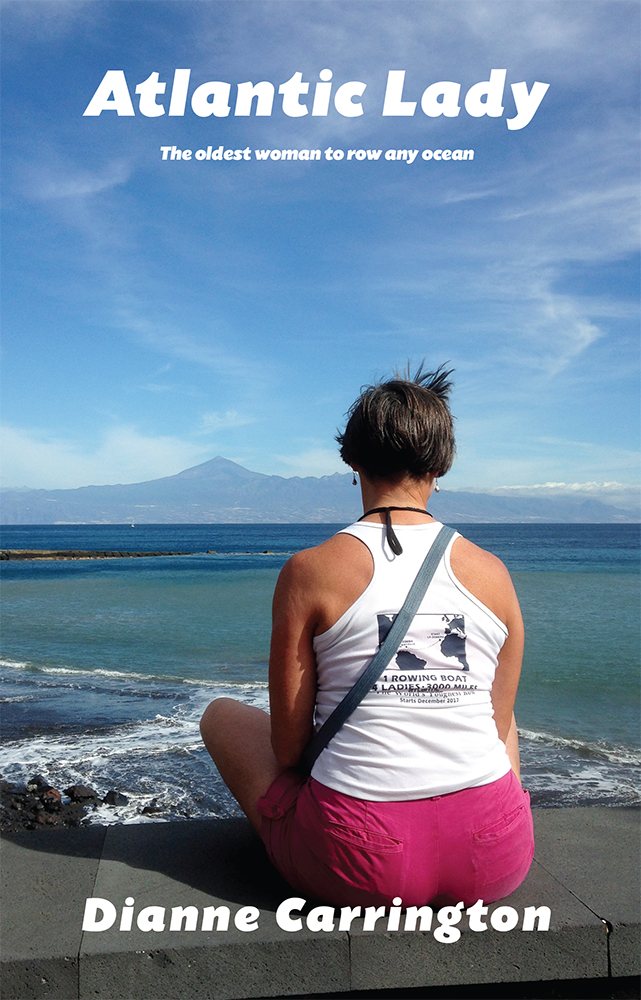
In the spring of 2016, recovering from burn-out and depression after many years in the NHS, Dianne Carrington was ready for a new challenge.
So when the phone rang and an old friend asked if she was ready to row the Atlantic in the Talisker Whisky Challenge, how could she say no?
She had always had an interest in outdoor activities and a big project like this was just what she needed to get back on track. Or was it? To row the Atlantic at any age is an undertaking beyond most of us but for a team of women in their sixties, and that was the idea that her friend was suggesting, it seemed almost impossible.
After all, the Talisker Whisky Challenge is one of the most demanding competitions on this planet.
At twenty-one I was in the Olympic squad for white-water slalom canoeing but left to take up my career. I taught outdoor pursuits for ten years by the sea. I've always loved the sea and canoed on it almost daily, challenging my limits. Then learnt that I couldn't have children and I trained as a nurse, working my way up the career ladder in the NHS. At fifty-five I had to end my career prematurely after I burnt out, having given more than 100%. I lost confidence and my body was racked with pain; I was in a bad place.
A team of wonderful people helped me get well again and I wanted to give something back. What better way than to raise money for charity and go back to the oceans that I love? Life is too short to not live it to the full.
I set out to gather a lovely team of ladies as close to my age as possible who would be passionate about rowing across the Atlantic with me. I wanted to inspire women and show them that we are never too old to do what we want to do. I wanted to help them embrace the courage to leave sight of the shore and to accomplish great things.”
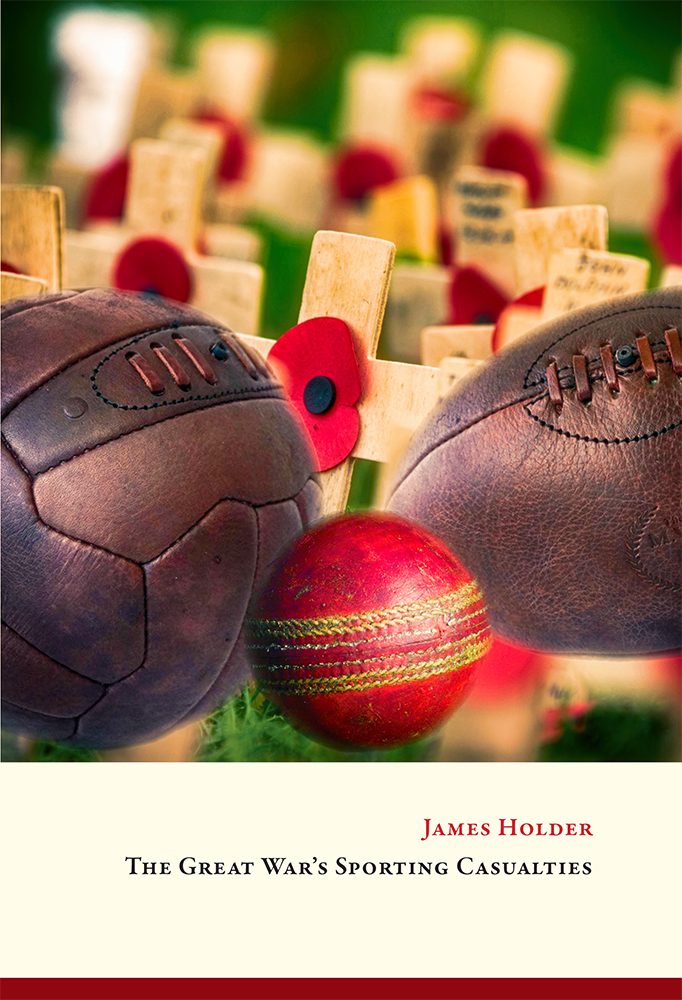
The Great War claimed the lives of many professional and amateur sportsmen, including over three hundred who had represented their countries in one sport or another. The Great War’s Sporting Casualties contains details of the sporting achievements and, where known, the circumstances of the deaths of those international sportsmen who were killed in the War or died as a result of injuries sustained in the War. It also contains details of nine other sportsmen who were killed in the War but who, although they did not represent their countries, did achieve something exceptional either in sport or in war.
Included amongst those listed are twenty-two Olympic gold medallists, twelve who captained their country at rugby, two who won the Tour de France and one who was a four-times Wimbledon champion. Also included are the three international sportsmen who won the Victoria Cross, one of whom was the only person to win two Victoria Crosses for deeds during the War and the fifteen who won the Military Cross.
James Holder was born in Somerset and, after reading law at Cambridge University, practised as a solicitor; he now works as a consultant. He is passionate about sport and has always taken an interest in family history much of which involves relations who were fortunate enough to survive the Great War. He and his wife have four children and one grandchild and live in Oxfordshire.
Reviews...
Andrew Brown, Oxfordshire
This is an impressively comprehensive guide to how the Great War led to the loss of so many top level sportsmen. While that in itself is not surprising –it led of course to the deaths of people from all walks of life-it is a stark reminder as to how many young, talented people were lost in the prime of their lives. The book focuses on international team sports - football, rugby and cricket - and Olympians and it is interesting to see the different rates of losses; for example, the worst hit proportionally were rugby players and Scottish rugby players in particular. The author surmises that this could be because a higher proportion of rugby players were privately educated and as a result officers who led from the front.
As well as the many fascinating and tragic individual stories in the main section of the book, I also enjoyed the appendices. One gives useful summary accounts of the many different Great War battles while one also details the losses by the internationals which they played; of the 30 players who participated in the January 1913 Scotland versus France rugby international, 14 were to die in the subsequent conflict.
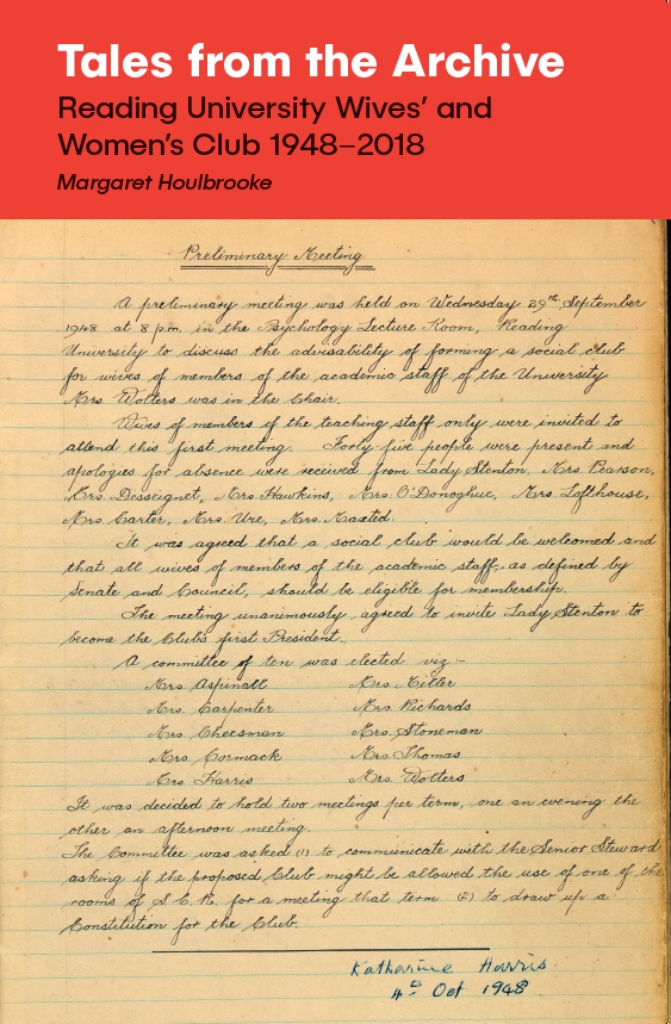
Reading University Wives’ and Women’s Club 1948–2018
The journey travelled by the University of Reading Women’s Club has mirrored the individual paths taken by very many women between the late 1940s and today.
This book brings to life the archives of seventy years and through them it is possible to note the changes in women’s lives and attitudes. Tales from the Archive is invaluable for the social historian as well as a memento for all Club members old and new.
When a delicious young man knocks on her door one morning, it is the first time Laura has ever met an heir-hunter. And she has no idea that she’s ever had a great aunt either, let alone one from whom she is to inherit a neglected eighteenth-century mansion called Hamilton Hall in Norfolk.
Who were the Boulais-Hamilton family anyway? And where does Laura fit in? After all, she grew up with a single mum and had no other living relatives, as far as she knew. And how did her late mother come to be estranged from the Boulais-Hamiltons if they were her kith and kin?
If this is no fairy story, how can Laura, a part-time undergraduate student and part-time care worker, possibly find the money to restore Hamilton Hall to its former glory, let alone afford to live in it?
The answers to these questions will change her life and tell a story that spans five generations from World War Two to the present day.
Annie Beaumont was born in Scotland and left before her first birthday. She was brought up in various places around England and the Far East. At 47, she began her Bachelor’s degree at Sussex University and went on to complete a Master’s at the University of East Anglia (UEA) and a PhD at Essex. She has taught sociology at Essex University and social sciences at The Open University. Annie is currently a student at the Unthank School of Writing in Norwich. Set in Wymondham, Norfolk, the county she made her own, Daughters of Hamilton Hall is Annie Beaumont’s first novel.
Reader Reviews
Amazon Reader Lovely read, heard about the book thanks to local newspaper.
Read in a day - could not put it down.
Characters were believable. Liked the time hopping element.
From the school visit we remember, to the local beat cop who helped us out, we trust the police and we respect them - all of them. Despite the occasional cover ups, the miscarriages of justice, the corruption and the hidden decisions, it’s very much in our British psyche to trust police managers because we trust the local cop.
What if we shouldn’t trust them? What if we really knew how a murder could be covered up? What if, under the surface, lay a secret brotherhood protecting the elite and the chosen?
Robert Moon describes a world where senior police managers are untouchable, celebrities and politicians are protected after committing evil crimes, and when one man stands against them there is nothing they won’t do to hide the truth. It’s fiction – or is it?
Robert Moon’s vivid descriptions, detail and accuracy to police procedures and management are rooted in twenty-one years serving the public at the front end of policing in Scotland.
Robert Joined 23 SAS, became “Sabre”, and a squadron member for four years before accidentally joining the police. He then walked, drove and ate ice cream in one of the toughest areas in Scotland for eight years before being exiled to the middle of nowhere. As the police changed from serving the public to serving statistics, he started to see a dark side to police-service and finally left the job, fed up of the corruption, nepotism and bullying, and after refusing his long-service medal. He now travels the world and complains a lot.
Reader Reviews...
Douglas Walker - The Sun Newspaper
Robert Moon has lived a full life. As part of the SAS he put his life at risk serving around the world.
After packing it in, he moved to the 'teuchter' branch of the Scots police expecting a simple life. Instead he was met by bent coppers and corruption dripping through the ranks from the highest echelons of the force.
Written with gallows humour, Moon is left deeply traumatised by what he experienced.
His description of front-line policing is too shocking to believe.
Millions of letters were written home by soldiers and sailors in the First World War and the men from Chiswick, West London, were every bit as prolific as their companions from elsewhere. Most of the letters in this book were sent to the Rev. Oldfield in Chiswick and he sent them on to the Chiswick Times, but there are others are to relatives, friends and employers and the Chiswick Working Men’s Club, and there are interviews and reports from journalists in the Chiswick Times and the Acton Gazette.
This is a unique record of the experiences of servicemen from the district who served all over the world. They describe the horrors of the war, writing of ‘Jack Johnsons’ ‘Rum Jars’ and ‘Coal Boxes’ (all nicknames for enemy shells and bombs) although often with feigned indifference, but many do not touch on the horrors at all - perhaps to protect relatives and friends from anxiety. The war was not confined to the European Western Front and this book includes letters and reports from other parts of the world: India, Africa, Egypt, Palestine, Greece, Mesopotamia (present day Iraq), and the Dardanelles. There are even letters from Russia where British forces were engaged against the Bolsheviks after 1918.
John Howard Grigg was born in Feltham, Middlesex in 1935. He has lived in West London all his life apart from two years in Nottingham with relatives during the Second World War, and two years National Service with the RAF. He retired from the Midland Bank in 1987 and has always denied he was ever a bank manager. He served as a local councillor in Hounslow from time to time between 1958 and 1990. He is an amateur local historian specializing in local social and political history.
Step into a decade where political correctness was frowned upon, when parental guidance was almost non-existent, where Social Media only existed in the mind of an incarcerated lunatic and where 18” wide flares were considered the height of fashion.
Welcome to the 1970’s.
Join Steve on his fascinating journey during a time where his taste for adventure and mischief were allowed to flourish – and very often, allowed to grow totally out of control.
From working on a fairground at the age of 11, to following his beloved Man United around the country by the age of 14 – this is an eye-opening exposé of a young man who stumbled in and out of court during his teenage years.
Set amidst the backdrop of the miner’s strike, the fall of a government,dubious glamour, charming innocence and a touch of brutality – take a step back into a time when colour TV was considered new technology, where many a fashion crime was committed and when violence on the football terraces was considered a national past time.
Born in 1960 in Kingstanding, Birmingham (in the same council house, his mom was born in) Steve was the second oldest of five children and he was up to mischief from the day he started to walk. His dad was a self-employed builder and his mom did out-work for local factories and did various cleaning jobs. It was hard going in the mid 60’s and during the summer holidays and aged only six, Steve would be given a jam sandwich by his mom and told not to come back until teatime. He would spend most of his days exploring with friends in the near by Sutton Park. Steve moved to Aldridge, Walsall in 1968. Prior to moving to Aldridge, for a full school year, come rain or shine Steve commuted very day (without his parents of course) from Birmingham to Aldridge on the famous Harpers buses. Always a bright and inquisitive child, Steve struggled with school work and to reflect attention away from his academic failures, he was happy to play the class clown. As a teenager Steve started to follow his beloved Manchester United, home and away and made several appearances in front of the magistrates. Still very much struggling to learn his ABC’s Steve officially left school at 15 and immediately got himself ‘A Local’ and a job in the building trade. Steve stayed in the building trade until he was 20, then he moved on to bigger and better things.
With Forwords by Man United Legend Norman Whiteside & star of stage & screen actress Shobna Gulati
NORMAN WHITESIDE - Manchester United & Northern Ireland Legend!
‘I have known Steve for several years mainly through his interest in football memorabilia and of course Man United. The late 1970’s always reminds me of my Doc Martens days and travelling from Belfast to Manchester every weekend to train with Man United schoolboys - great times. Mainly through humour and sometimes heartache, Steve has certainly captured the mood of a teenage boy growing up in the turbulent 1970’s. Anyone who was around in the 70’s will immediately identify with Steve’s book.
I just know the book is going to be a great hit and will sell like cup-final tickets’
SHOBNA GULATI - Actor
‘Steve and I first met back in 2008 in very rowdy bar in Moscow. We were both in the Russian capital to see our beloved Manchester United win the Champions’ League. We have kept in touch ever since.
Steve has been lucky enough to lead a very exciting and well-travelled life and whenever we meet up, Steve has always been wonderful company and has great stories to tell.
I’m not the least bit surprised Steve has decided to put his experiences down on paper and I am in no doubt that Steve’s book will be a great success’
When you have produced the final draft of your book, it is always advisable to have the text read and checked by a professional editor or proof reader.
You may have friends that are willing and competent to do this and we can advise you on the type of editing that is required.
We can offer four levels of editing as well as proof-reading.
You choose which, if any, are appropriate in your case: 1. Edit of sample pages and short report (£30)
We will edit a few pages to highlight editorial issues so that you can look for similar problems throughout the book.
This will reduce the amount of further copy-editing required when the book is finished. 2. Broad structural editing and criticism (£5 per thousand words)
A structural review is particularly relevant for works of fiction.
The structural reviewer will address the following main areas and produce a short report for the author ” Read More 3. Copy editing (£10 per thousand words)
A copy-editor takes a close look at your text, line by line, with an eye to grammatical errors, repetition, inconsistency and lack of clarity. The copy editor will make changes to the text, with suggestions for rewriting, grammar, and punctuation. When you receive the edited version, you have the final choice about accepting of rejecting the individual changes. 4. Proof Reading (£8 per thousand words)
Proof reading is a line-by-line check that the book is ready for publication. Proof readers will make small corrections for punctuation, grammar and spelling but they will not make significant changes to the text.
A proof reader will identify any significant issues and add comments to the text so that you can make those corrections yourself. 5. Consistency Scan
If you decide your book doesn’t need a full proof reading, we offer an electronic scan to search for common errors and inconsistencies. This looks at issues such as inconsistent spelling and inconsistencies of hyphenation and capitalisation.
We can also identify inconsistencies in the spelling of proper names. 6. Cover text
The quality of the text on the cover is very important as it indicates the quality of the writing in the book.
The title, sub-title and back-cover blurb are all important elements and we can work with you to make sure that these are correct and effective.
Copy Edit
Copy-editors get the raw material into shape for publication i.e they edit the copy.
When they have finished, the designer can lay out or typeset the book and produce a proof.
It is quite normal for the author to make additional changes after a book has been copy-edited.
Working through the material, the copy-editor may identify errors in spelling, punctuation, grammar, style and usage, but also very long sentences and overuse of italic, bold, capitals and exclamation marks.
They should correct or query doubtful facts, weak arguments, plot holes and gaps in numbering.
In fiction, they should also check that characters haven’t changed their name or hair colour, look for sudden changes from first to third person among other things.
The Copy-editor is not a proof reader and should not be expected to find all of the errors in the text particularly if the text is badly written to start with.
This is the job of the proof reader.
The final proof should be checked by a proof reader or an experienced reader friend before going to print.
It is almost inevitable (and acceptable) to miss a few errors which can be corrected in a later edition.
Proof Reading
Proof reading is a line-by-line check that the book is ready for publication.
Proof readers will make small corrections for punctuation, grammar and spelling but they will not make significant changes to the text.
A proof reader will identify any significant issues and add comments to the text so that you can make those corrections yourself.
If you have decided to complete this stage of the process yourself, we will send a detailed check-list to help you.
We ask you to try and ensure that the book is completely ready before we start the layout.
Once the layout has started, we expect that you might want to to make a small number of amendments but
if there are a significant number, we may need to charge for the extra time it takes to change the layout
so best to discuss this with us first.
Structural Review
In fiction, the main areas that a structural editor will address are:
Plot: Does the plot make sense? Is it believable? Is it satisfying or does it leave the reader frustrated? Themes: Are the themes effectively handled? Are there so many that the book lacks focus? Do they interfere with the plot or complement it?
Characterisation: Are your characters well developed and believable? Are they cast in a role that fits their personality? Do they sometimes behave out of character? Point of view/voice: Is the voice consistent or is it sometimes confused? Is the voice authentic? Are you using too many or too few POVs? Pace: Does the plot move forward at an appropriate pace? Should you cut that preface? Should the action happen sooner or should the tension build more slowly? Dialogue: Do your characters sound real when they speak? Is your dialogue cluttered with adverbs and beats? Do you use clunky dialogue to move the plot forward? Flow: Is the narrative interrupted by dead-ends and tangents? Is there so much back story that the main plot is dwarfed? Are there missing plot points that would give the narrative greater integrity?
In non-fiction, the principle is the same, but the specific issues are slightly different:
Thesis: Is your thesis relevant? Is it clearly defined or is it lost among marginal issues? Exposition: Are your arguments clear and cogent? Are they well researched and properly supported? Do they have a clear relationship with your thesis? Content: Are all the necessary topics sufficiently dealt with? Are the chapters weighted correctly? Is there superfluous content? Organisation: Is the information organised logically? Are tables and illustrations used appropriately? How many levels of subheads do you need and how should they be arranged? Tone: Is the tone appropriate for the audience? Do you need to eliminate jargon? Is the text accessible? Pace: Are there passages that are bogged down in detail? Do you spend too long on detail irrelevant to the main thesis? Are there areas that need further exposition lest they be skipped over?
Cover Text
The quality of the text on the cover is very important as it indicates the quality of the writing in the book.
The title, sub-title and back-cover blurb are all important elements and we work with you to make sure that these are as effective as possible.
Consistency check
If you decide your book doesn’t need a full proof reading, we can run an electronic scan to search for common errors and inconsistencies.
This looks at issues such as inconsistent spelling, hyphenation and capitalisation.
It also checks for consistent formatting of numbers and dates as well as undefined abbreviations.
Full Script Edit
The script that you deliver to us will probably constitute what the industry would classify as the ‘Initial Rough Draft’, i.e. a full screenplay written without any other professional input or advice, and probably without a great deal of rewriting. We work through your draft, line by line, scene by scene, and come back to you with a comprehensive set of notes from which you can then work towards the official ‘1st Draft’. Some of our notes will be broad and general, dealing with such areas as the overall shape and structure, pacing, plot and character development; others will be far more specific, with corrections, clarifications and suggested cuts etc. It is of course entirely up to you whether or not to take these suggestions on board, and to what extent.
Subsequent Script Edit
It is very normal and generally beneficial for the script-editing process to go through at least a couple of cycles
i.e. the rewritten draft to be worked through once again by an experienced script practitioner – though this would be entirely at the discretion and behest of the writer.
Ongoing Support
We aim to make your self-publishing venture an enjoyable and rewarding experience.
Publishing is a complex business and we treat every book as a separate project.
We explain all of the stages at the outset and we manage the project schedule for you. This will include all of the expert services you have requested for editorial, design, printing, distribution and collection of royalties, keeping in close contact with you throughout the process.
You will be allocated a project-sheet on the YouCaxton website so that you can monitor progress and ensure that all stages are properly completed.
If you would like to see an example of a Project-Sheet…
go to My project on the menu and enter…
Username: Sample
Password : welcome.