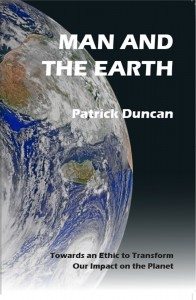
Man and the Earth: Towards an Ethic to Transform our Relationship with the Planet
THIS BOOK, written fifty years ago, was among the first calls for a new system of values to govern the relationship between humanity and our planet. It has at least two claims on our attention. First, it contains a passionate and reasoned plea for the rights of non-human life. Second, Patrick Duncan proposes a new ethic which might enable fractious humanity to come together and help save the world from disaster.
Patrick Duncan was exceptional in being an innovative thinker with a breadth of understanding which spanned philosophy, ethics, law and science; and a political activist who dedicated his life to bringing an end to apartheid in his native South Africa. His biography was written by C.J.Driver Patrick Duncan: South African and Pan-African. James Currey (2000).
See also: wikipedia.org/wiki/Patrick_Duncan (anti-apartheid_activist)
Buy from YouCaxton (UK only)
£10.00 (+ £2 postage)
Man and the Earth is being republished fifty years on, because of its continuing relevance to some of the greatest global public policy challenges of the 21st century: the impact of humanity on our environment (climate change, biodiversity loss, etc.), and inequality of opportunity. The book makes exhilarating reading when Duncan describes the beauty of the world and human creativity. He does not flinch when reacting against the destructive side of humanity, and his anger and disgust are reminiscent of Swift. This is deeply personal, and many readers will disagree with some of his analyses. They will also be surprised, charmed, and moved.
From Sir Peter Scott’s introductory message... ... This book suggests an ethical approach which might serve to unite humanity ... I hope it will be read by all those who believe that the present philosophy of maximisation must be replaced by a new concept of high-quality human living ...
Reviews...
Dr. George Monbiot, Writer and Journalist at The Guardian This is a remarkably prescient book. Written at a time when technological optimism appeared to sweep all before it, Man and the Earth identifies some of the great themes that later came to dominate.
Cormac Cullinan, environmental activist, lawyer and author of Wild Law Man and the Earth is a book for the 21st Century which explains with great clarity why humanity cannot prosper unless we unite behind a common ethic centred on what is of greatest value to us all – Earth. The clarity, breadth and foresight of Patrick Duncan’s analysis and proposals for a way forward are all the more extraordinary for having been written in the 1960s. With the benefit of half of century of hindsight his discussions of ideology, population increase, global warming, the depletion of the ozone layer, the destruction of wild places, and the extinction of species seem prophetic. Yet global society is only now beginning to explore the solutions that he proposed. Only in the last few decades have serious attempts been made to determine the “budgets” that he proposed for establishing the ecologically sustainable limits of human impacts. Even more recent is the emergence of a global movement that advance his insight that it is essential to embrace the establishment of a balance and harmony between humanity and rest of the community of life as the purpose of life, and that achieving this requires fostering our inherent love of Earth. The fate of most, even all, of humanity will be decided during the first half of this Century. One of the best ways of enhancing our prospects is to read and act on Duncan’s insights. The Duncan family deserve credit for republishing a book that was so ahead of its time, now, when its time has come.
Satish Kumar, Editor-in-Chief, Resurgence & Ecologist magazine and Founder, Schumacher College Patrick Duncan was a prophet ahead of his time. His seminal book, Man and the Earth is at once visionary, profound and practical. Patrick Duncan reminds us again and again that we mistreat our planet home at our peril. Man and the Earth is a lucid engaging read, wisdom and deep insight leaps out of every page. The essential message of the book is very simple and clear; take care of the earth and the earth will take care of you. Furthermore, Patrick Duncan makes it clear that nature is not merely a resource for our economy, nature is the source of life. Even though the book was written 50 years ago, it is as relevant today as it was then.
If you are studying a written subject at university and want to succeed, you will need to know how to apply study skills effectively. Based on a decade long experience in teaching, Kyriacos Papasavva helps you develop the essential skills which will enable you to improve your essay writing and exam technique, and therefore succeed at university. Uniquely, this guide merges everyday study skills with a critical approach to your studies; required for philosophy, theology and ethics students particularly.
This guide will help you:
Understand marking criteria at university.
Write well-structured essays.
Develop a critical & reflective study skills approach.
Manage your time throughout the academic year.
And much more.
Kyriacos Papasavva is a study skills tutor at the University of London a KS3-5 teacher and a private tutor. He has taught students from the University of Saint Andrews, Heythrop College, Brunel University, Eton, Harrow School and a host of colleges and 6th forms throughout England.
Healing the Hurts of Capitalism From Isolation to Connection How do we break old habits and routines that stop us making progress? In organising politically, how do we escape ways of doing things that are either self-defeating or out of date? Those involved in radical politics frequently put their heads in their hands in despair as old habits die hard – too often they are as destructive as ever. Or attempts to break the mould seem as eccentric and counter-productive as the patterns they would replace. It seems that we are on rails, travelling to a destination that has already been determined. How to escape? Let’s open the book and see what Micheline and Alan suggest … Ken Loach – Film maker
Micheline Mason is an artist, writer and activist. For over forty-five years she was part of an international organisation of people who developed a simple but profound way to help each other to recover from past emotional injuries. In this community she helped develop the theory and became a teacher of the method, exchanging attention with thousands of people in many different countries. In her ‘retirement’ she has chosen to share what she learnt with as many people as possible with a view to empowering them to continue the work themselves.
She lives in London.
Reviews...
Thoughtful and Different Healing the Hurts of Capitalism offers an interesting explanation of why the capitalist system remains the status quo and why attempts to change it result in failure. Rather than dwelling on economics and politics it tackles the downside of capitalism from the standpoint of our own psychological distress ‘patterns’. Patterns are entrenched behaviour patterns which result from past hurts and they dictate our responses to the world around us and to our own relationships and situations in ways that are less than appropriate or helpful.
‘Patterns’ such as the pursuit of excessive wealth, compulsive shopping to make us feel better, addictions, fearing people different from ourselves, competitiveness, feelings of isolation and powerlessness are bad for us as individuals but en masse they prevent our own growth and the growth of civilisation into something more humane, more sustainable, more cooperative and more equal. A good and interesting read and very accessible unlike many books on the subject.
Susan Harris - Great Read Wow what a brilliant book and it is written in very accessible way.
It has a new approach using a diverse group of peoples personal experiences and thinking to illustrate the impact of Capatalism in their lives.. This makes it a a wonderful alternative to the academic explanations. It brings clarity to the complexities and mechanics of the present system and offers ways to support each other to build a better society.
Stefan Szczelkun Many of us who have experienced peer counselling, or perhaps have been through a process of recovery from addictions or trauma with the intensive use of professional counselling, have a political insight into the way that the forces that hold our class system together are embedded in us from an early age. The political landscape is founded on feelings of superiority and inferiority that don’t seem to be accessible to rational analysis or challenge.
There are many thousands of people scattered through the population that have acquired these insights over the last 30 or 40 years but communicating them to the rest of the world has not happened. Part of the difficulty may have been that the knowledge gained through live and emotionally charged interaction does not translate into words on a page or screen. The clever thing that the authors of ‘Healing the Hurts of Capitalism’ have done is to base their book on transcriptions from a series of listening workshops in which the participants respond to questions about their experiences in relation to capitalism. The many quotations from these workshops give the reader an stronger idea of the process that is being proposed. In fact the book ends with a chapter on how to set up a successful listening group.
The idea is to infuse grass roots politics with a process of communication that could liberate us from the stultifying effects of the everyday oppressions we have been subject to and that have limited our power. Its an ambitious book that is written in very accessible language. I’d recommend it to anyone who wants to find a more caring form of political practice.
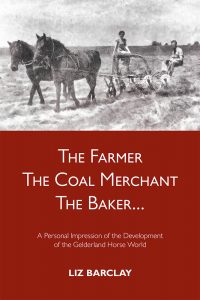
In the fifties and sixties of the previous century the province of Gelderland gradually became the hub of the warmblood breeding world in the Netherlands.
Stallions, such as Amor, Pericles and Voltaire, just to name a few, became household names whereas the local breeders using these stallions had no idea that, in a matter of just thirty or forty years, this would lead to the international fame of the Dutch warmblood of today.
Liz Barclay grew up in Gelderland during that time and, having lived in the States before settling in Cornwall in the United Kingdom, she saw that what once was a local enterprize has now become a huge international business. As a horse trainer she worked in both countries with many warmbloods, who had the blood in their veins from stallions who, during her youth, did not live very far from her doorstep.
The stories of breeders Henk Nijhof and Johan Venderbosch and trainers Roeli Bril and Jan Oortveld, men she knew, or knew of, during her youth in Gelderland, give a wonderful impression, not only of how life was, but also how life changed.
Starting with the breeding lines of Totilas and Valegro as the prime examples of the Dutch breeding success, the book, with Liz’s younger years as the common thread, gives owners of a Dutch sport horse anywhere in the world the chance to connect the breeding papers of their warmblood to this heartwarming tale of some brave Gelderland horsemen, who dared to stick their neck out, never shy of taking a little risk. Liz Barclay grew up in Gelderland before settling on her smallholding in Cornwall. She has worked with horses for most of her life, which gave her the chance to know breeders such as Henk Nijhof and Johan Venderbosch and learn from trainers such as Roeli Bril and Jan Oortveld.
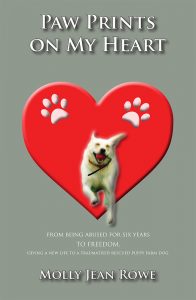
Shy, the traumatised Labrador rescued from a puppy farm, arrives on the brink of a breakdown.
Several months after losing their German Shepherd, Molly and her husband John decide
to look into re-homing an elderly dog or a dog with special needs.
Along came Shy, a six year old Labrador, terrified of people and desperately in need of a loving home.
It was never going to be easy taking on such a very needy dog.
Paw Prints on My Heart lets you share the first twelve months of the journey that turned this little dog’s life around. It’s a very personal and true story that has been written to encourage people who are thinking about adopting a rescue dog, to open their hearts and let a sorry little soul in.
Published:
June 2017
Paperback:
200 pages
Price:
£8.50
ISBN:
9-781911-175704
Available direct from the author
£8.50 (Free Postage) Number of copies:
Molly Jean Rowe is not a celebrity or a writer; she’s a housewife, a wife, mother, grandmother and great-grandmother who loves her family and has a great love of animals especially horses and dogs.
At an early age in Molly’s life her father brought home a collie puppy. It was the runt of the litter and Molly fell in love. They were inseparable. This marked the beginning of her love for dogs. Throughout her life, Molly has had many dogs, most of them rescue dogs. She has given them a loving home for life.
Molly was never able to own a horse until she was in her mid-forties but since that time she has owned six horses and has never sold one of them; just like her dogs, they have a home for life. She loves riding and showing her horses in hand and has many rosettes.
Writing her first book was not easy but Molly wanted people to understand the ill treatment that takes place in some puppy farms and the trauma that many dogs suffer, in the hope that it will contribute in some way to their welfare.
The Shropshire Botanical Society is a not-for profit organization that is open to all botanists in the county and elsewhere, whatever their level of botanical skill. We hold field meetings, produce a bi-annual newsletter and hold indoor meetings with speakers. Our main remit is to provide a forum for recording the distribution of vascular plants, bryophytes and stoneworts within the vice-county, to provide botanical recording data for the conservation of plants and their habitats, and to provide training opportunities for botanists who wish to improve their identification or recording skills. All of our members and committee officers are volunteers and we always welcome new botanists.
Many of our members also belong to the Botanical Society of Britain and Ireland, the national organization for all amateur and professional botanists.
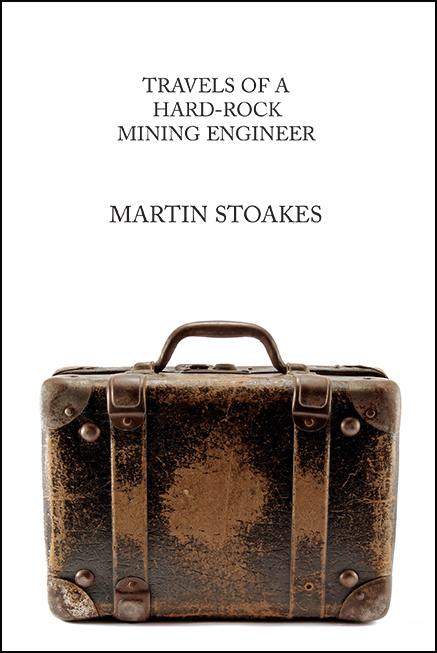
Travels of a Hard-Rock Mining Engineer is a chronicle of the travels and experiences of a hard-rock mining engineer during the last half of the 20th century. It gives a vivid and an instructive insight into the generally little known subject of hard-rock mining, often in remote locations. Various mining projects are described in detail and provide a fascinating insight into the complexities of mine design and evaluation.
Martin Stoakes worked on 125 mining projects in thirty-seven different countries over a forty-four year period. His graphic account of the sometimes nerve-racking conditions and locales that he experienced includes encounters with Shining Path guerrilla fighters in Peru, MNLF Islamic fundamentalists in the Philippines and the RPF guerrillas in Rwanda/Uganda. Hard rock mining was never for the faint-hearted.
Murderous fighters notwithstanding, the author's passion for narrow-boating, walking, cycling and his love of dogs give a tranquil balance and, from the early 1980s, there is a touching account of the trials and tribulations of first fostering, then adopting and raising a son into his family.
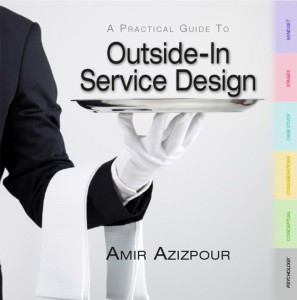
Outside-In Service Design is a User-Centred approach to designing products
and services, aiming to give the customer a unique and memorable
experience as well as optimising the business processes.
Customers are the main influence on the design - the better the
experience, the more chance you will have of customer retention
and loyalty.
This book takes us on a practical journey to understand, appreciate and apply the
Service Design approach:
* Seeing things from the customer perspective
* 14 Practical Stages of Outside-In Service Design
* How Service Design is used during business development.
* 17 Key Considerations during Service Design
* How conceptual design benefits business
* Groundbreaking theory of user expectations and experience
Amir Azizpour has a background in business, technology and psychology with a
passion for delivering unique and innovative solutions to ensure the highest levels
of user satisfaction, experience and loyalty. He has more than 30 years experience
in applying Service Design concepts to all aspects of business including Customer
Services, Training, and Product Design as well as providing consultancy on Business
Process, Management and Software Design.
His passion is to spread the Service Design model through training, assessment
and consultancy. I believe proper application of Service Design can seriously improve the quality of our
lives. Conversely, poorly designed products and services cause stress and lower the
quality of life for the users. My mission is to identify poorly-delivered products and
services and help to improve them.
Amir Azizpour
When you have produced the final draft of your book, it is always advisable to have the text read and checked by a professional editor or proof reader.
You may have friends that are willing and competent to do this and we can advise you on the type of editing that is required.
We can offer four levels of editing as well as proof-reading.
You choose which, if any, are appropriate in your case: 1. Edit of sample pages and short report (£30)
We will edit a few pages to highlight editorial issues so that you can look for similar problems throughout the book.
This will reduce the amount of further copy-editing required when the book is finished. 2. Broad structural editing and criticism (£5 per thousand words)
A structural review is particularly relevant for works of fiction.
The structural reviewer will address the following main areas and produce a short report for the author ” Read More 3. Copy editing (£10 per thousand words)
A copy-editor takes a close look at your text, line by line, with an eye to grammatical errors, repetition, inconsistency and lack of clarity. The copy editor will make changes to the text, with suggestions for rewriting, grammar, and punctuation. When you receive the edited version, you have the final choice about accepting of rejecting the individual changes. 4. Proof Reading (£8 per thousand words)
Proof reading is a line-by-line check that the book is ready for publication. Proof readers will make small corrections for punctuation, grammar and spelling but they will not make significant changes to the text.
A proof reader will identify any significant issues and add comments to the text so that you can make those corrections yourself. 5. Consistency Scan
If you decide your book doesn’t need a full proof reading, we offer an electronic scan to search for common errors and inconsistencies. This looks at issues such as inconsistent spelling and inconsistencies of hyphenation and capitalisation.
We can also identify inconsistencies in the spelling of proper names. 6. Cover text
The quality of the text on the cover is very important as it indicates the quality of the writing in the book.
The title, sub-title and back-cover blurb are all important elements and we can work with you to make sure that these are correct and effective.
Copy Edit
Copy-editors get the raw material into shape for publication i.e they edit the copy.
When they have finished, the designer can lay out or typeset the book and produce a proof.
It is quite normal for the author to make additional changes after a book has been copy-edited.
Working through the material, the copy-editor may identify errors in spelling, punctuation, grammar, style and usage, but also very long sentences and overuse of italic, bold, capitals and exclamation marks.
They should correct or query doubtful facts, weak arguments, plot holes and gaps in numbering.
In fiction, they should also check that characters haven’t changed their name or hair colour, look for sudden changes from first to third person among other things.
The Copy-editor is not a proof reader and should not be expected to find all of the errors in the text particularly if the text is badly written to start with.
This is the job of the proof reader.
The final proof should be checked by a proof reader or an experienced reader friend before going to print.
It is almost inevitable (and acceptable) to miss a few errors which can be corrected in a later edition.
Proof Reading
Proof reading is a line-by-line check that the book is ready for publication.
Proof readers will make small corrections for punctuation, grammar and spelling but they will not make significant changes to the text.
A proof reader will identify any significant issues and add comments to the text so that you can make those corrections yourself.
If you have decided to complete this stage of the process yourself, we will send a detailed check-list to help you.
We ask you to try and ensure that the book is completely ready before we start the layout.
Once the layout has started, we expect that you might want to to make a small number of amendments but
if there are a significant number, we may need to charge for the extra time it takes to change the layout
so best to discuss this with us first.
Structural Review
In fiction, the main areas that a structural editor will address are:
Plot: Does the plot make sense? Is it believable? Is it satisfying or does it leave the reader frustrated? Themes: Are the themes effectively handled? Are there so many that the book lacks focus? Do they interfere with the plot or complement it?
Characterisation: Are your characters well developed and believable? Are they cast in a role that fits their personality? Do they sometimes behave out of character? Point of view/voice: Is the voice consistent or is it sometimes confused? Is the voice authentic? Are you using too many or too few POVs? Pace: Does the plot move forward at an appropriate pace? Should you cut that preface? Should the action happen sooner or should the tension build more slowly? Dialogue: Do your characters sound real when they speak? Is your dialogue cluttered with adverbs and beats? Do you use clunky dialogue to move the plot forward? Flow: Is the narrative interrupted by dead-ends and tangents? Is there so much back story that the main plot is dwarfed? Are there missing plot points that would give the narrative greater integrity?
In non-fiction, the principle is the same, but the specific issues are slightly different:
Thesis: Is your thesis relevant? Is it clearly defined or is it lost among marginal issues? Exposition: Are your arguments clear and cogent? Are they well researched and properly supported? Do they have a clear relationship with your thesis? Content: Are all the necessary topics sufficiently dealt with? Are the chapters weighted correctly? Is there superfluous content? Organisation: Is the information organised logically? Are tables and illustrations used appropriately? How many levels of subheads do you need and how should they be arranged? Tone: Is the tone appropriate for the audience? Do you need to eliminate jargon? Is the text accessible? Pace: Are there passages that are bogged down in detail? Do you spend too long on detail irrelevant to the main thesis? Are there areas that need further exposition lest they be skipped over?
Cover Text
The quality of the text on the cover is very important as it indicates the quality of the writing in the book.
The title, sub-title and back-cover blurb are all important elements and we work with you to make sure that these are as effective as possible.
Consistency check
If you decide your book doesn’t need a full proof reading, we can run an electronic scan to search for common errors and inconsistencies.
This looks at issues such as inconsistent spelling, hyphenation and capitalisation.
It also checks for consistent formatting of numbers and dates as well as undefined abbreviations.
Full Script Edit
The script that you deliver to us will probably constitute what the industry would classify as the ‘Initial Rough Draft’, i.e. a full screenplay written without any other professional input or advice, and probably without a great deal of rewriting. We work through your draft, line by line, scene by scene, and come back to you with a comprehensive set of notes from which you can then work towards the official ‘1st Draft’. Some of our notes will be broad and general, dealing with such areas as the overall shape and structure, pacing, plot and character development; others will be far more specific, with corrections, clarifications and suggested cuts etc. It is of course entirely up to you whether or not to take these suggestions on board, and to what extent.
Subsequent Script Edit
It is very normal and generally beneficial for the script-editing process to go through at least a couple of cycles
i.e. the rewritten draft to be worked through once again by an experienced script practitioner – though this would be entirely at the discretion and behest of the writer.
Ongoing Support
We aim to make your self-publishing venture an enjoyable and rewarding experience.
Publishing is a complex business and we treat every book as a separate project.
We explain all of the stages at the outset and we manage the project schedule for you. This will include all of the expert services you have requested for editorial, design, printing, distribution and collection of royalties, keeping in close contact with you throughout the process.
You will be allocated a project-sheet on the YouCaxton website so that you can monitor progress and ensure that all stages are properly completed.
If you would like to see an example of a Project-Sheet…
go to My project on the menu and enter…
Username: Sample
Password : welcome.