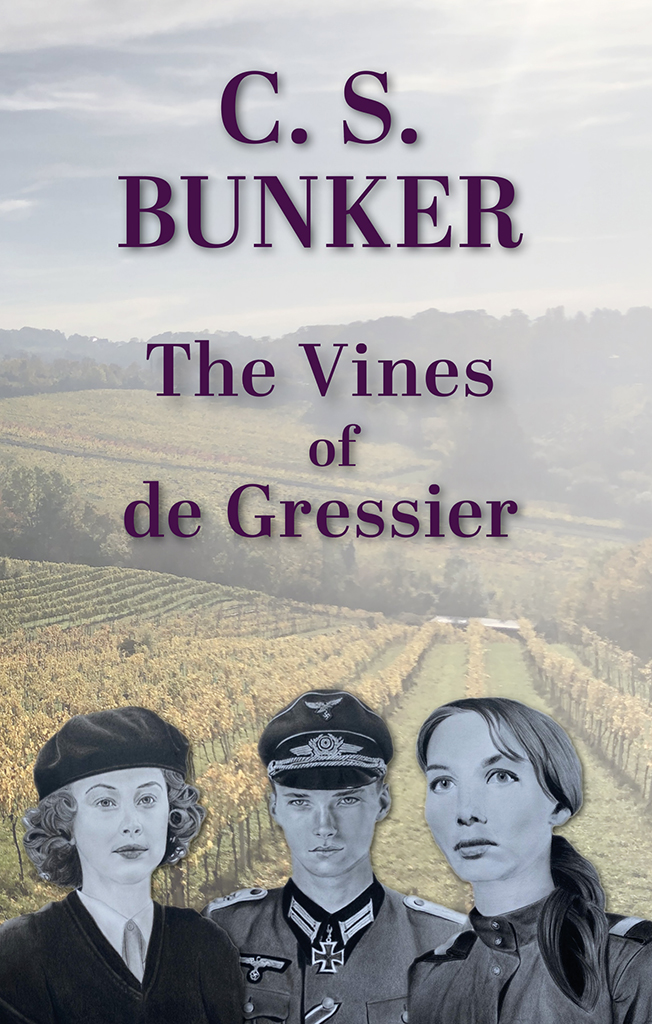
The Vines of de Gressier
Book 2 of the de Gressier Quartet
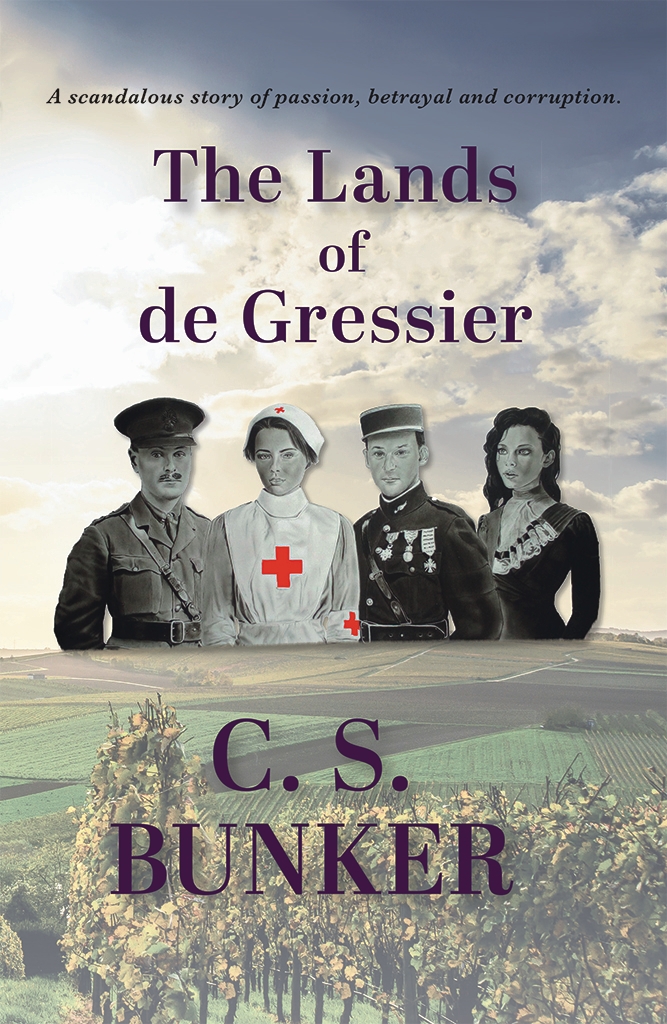
When the German army occupies Bordeaux in August 1940, the lives of Juliette Guégan, David Daunier and Dominique Hilaire are again thrown into flux; but it is the arrival at Château de Gressier of Leutnant Heinrik Klugman, a pilot in the Luftwaffe, which twists the kaleidoscope of their lives and sends them in different directions.
Once again, war creates a series of moral and ethical dilemmas to be navigated. Should you put the lives of your family at risk to work with the Resistance? Should you find comfort in the arms of your best friend’s son? How do you fight collaboration and corruption when it pervades the reputation of the very institution you have sworn to uphold? Should there be a penalty for going to the bed of your family’s enemy? Should love deny differences in age and race?
For Australia and USA, please order from Amazon.com
Set against the vineyards of Bordeaux and South Africa, and the battlefields of the Eastern Front, The Vines of de Gressier continues as a story of love, betrayal, corruption and, above all, human resilience.
With much-loved characters from The Lands of de Gressier, C.S. Bunker has written another well-researched page-turner, with clever plots and sub-plots, all interwoven with people and events of history. Another must-read!
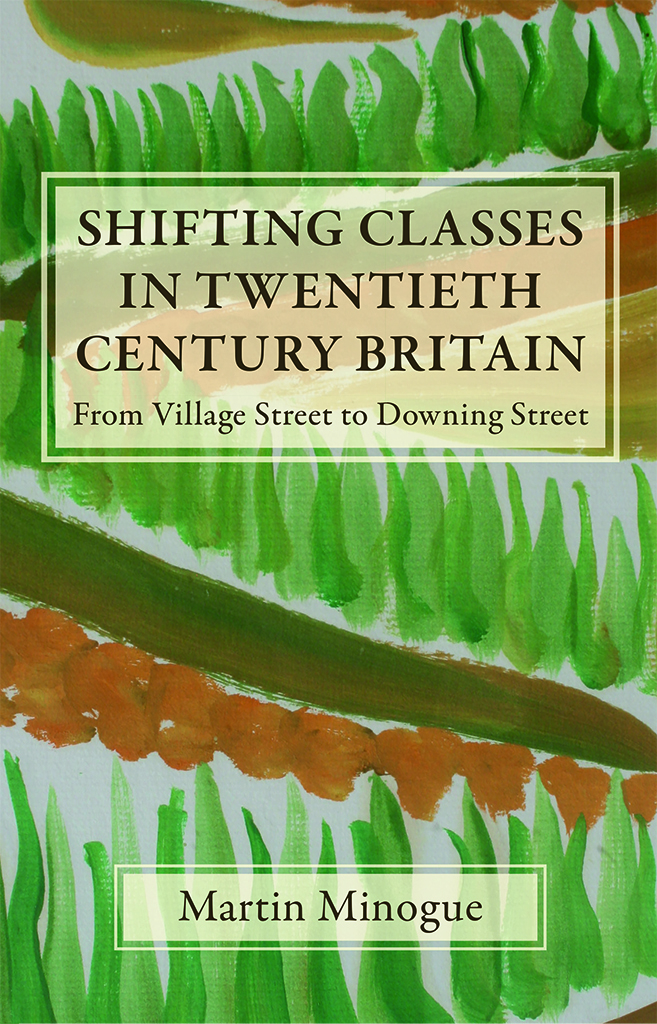
Shifting Classes in Twentieth Century Britain
From Village Street to Downing Street
Martin Minogue
An unconventional family story, told with warmth and humour, this account details the mixed fortunes of a rural labouring family, a neglected group in British working-class history.
The author’s progress from farmworker’s tied cottage to Cambridge University then to a Foreign Office flat in Downing Street is remarkable, as is the heroism of the working-class parents who made that transition possible.
The description of shifts in social relations produced by such sharp movements between different classes illuminates current debates about the persistence of centuries-long inequalities.
Martin Minogue was educated at King James Grammar School, Knaresborough then at Cambridge University, graduating in History. In 1962 he entered the Foreign and Commonwealth Office in Whitehall where he held posts as a Resident Clerk, and as Private Secretary to successive Secretaries of State (Duncan Sandys and Arthur Bottomley). He subsequently pursued an academic career in politics and government at the Universities of Kent, then Manchester, where he became Director of University’s International Development Centre. He held consultancies for the World Bank, the United Nations Development Programme, the UK Department for International Development and the British Council. Now retired, he lives in Wales.
Reviews...
Professor Quentin Skinner, School of History, Queen Mary University of London A memoir of general and even exemplary significance, Shifting Classes begins in a Yorkshire village and ends amid the mandarins and politicians of Westminster and Whitehall. While both settings give rise to some marvellous comic set-pieces, the North-country background also provides a shocking account of deprivations endured and opportunities denied. There have been few accounts of rural working-class life and conditions in twentieth century Britain, and nothing that matches Shifting Classes for its vividness of detail and its power to reveal the injustices that kept the class-system in place.
Fred Inglis, Emeritus Professor of Cultural Studies, University of Sheffield This is a rare, truthful and utterly appealing memoir, a ‘condition of England’ book that is at the same time a happy book, entirely without rancour.'
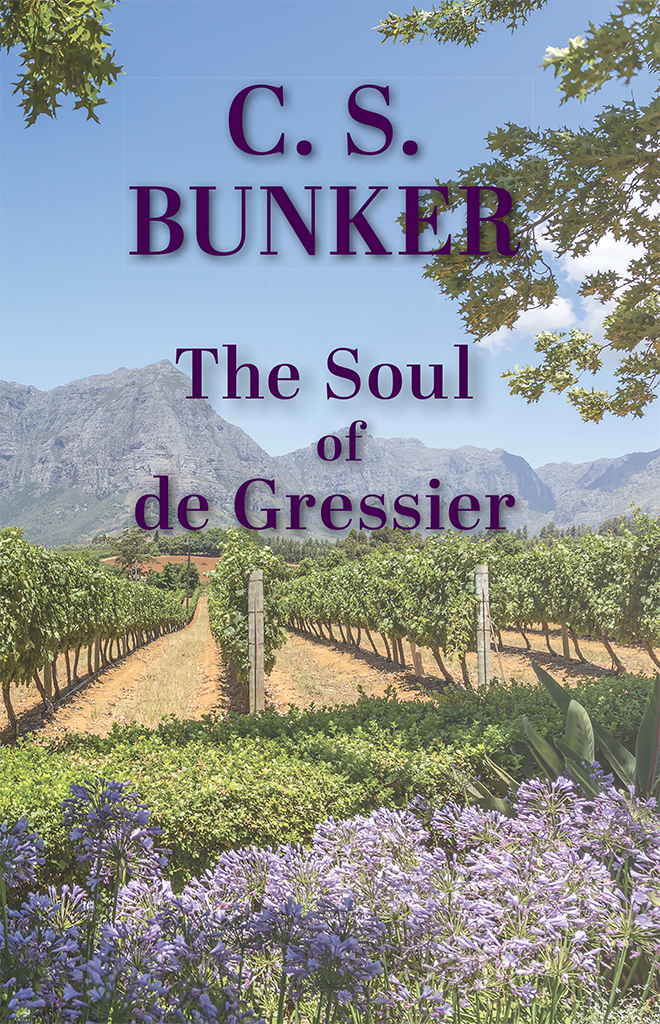
The Soul of de Gressier
Book 3 of the de Gressier Quartet
Henry Bellanger, the heir apparent to the de Gressier vineyards in Bordeaux, was born with a silver spoon in his mouth, and a secret.
David Daunier, a fugitive from British ‘justice’ and the owner of a successful vineyard in the winelands of South Africa, lives under the tyranny of apartheid and has a secret.
Sophie Elleswell, a young German ‘million-dollar’ supermodel, unwittingly carries deep within her psyche, her mother’s secret.
Set against the backdrops of vineyards and wineries, the dealings of the drug and wine trades, and the intrigues of the City of London, the happenchance of life brings the Bellanger, Daunier and Elleswell families happily together until crime and corruption involve them in events beyond their control.
Using his style of short chapters, intermingling plots and sub-plots, and strong and engaging characters, C.S. Bunker has created another gripping page-turner of love, passion, dishonesty, betrayal, tragedy and this time, revenge!
C.S. Bunker is a former international corporate financier. Using over thirty years of business experience and a lifelong interest in history and politics, Bunker started to write because he had a series of truth-based stories he wanted to tell. Inspired by three very personal songs and places he knew, his first four interconnected books took over twelve years to plan and research, followed by seven years of dedicated crafting and writing.
The Watches of de Gressier
Book 4 of the de Gressier Quartet
When Henry Guégan arrives in Moldova to help privatise its wine industry, he has no idea how dramatically his life is going to change. The country is coming out from under the yoke of communism and is in the vice-like grip of the mafia, gangsters and political corruption.
Falling in love with Tania Plesca, and with the vineyards of Moldova capturing his heart, Henry is driven by ambition. He becomes deeply involved in the moral and ethical dilemmas facing the country, but with devastating effect on him and all those around.
Running for his life, Henry leaves Moldova with the answer to the question that had plagued him since childhood, and with a secret; both are later uncovered by his sons and revealed to the world in a public and climactic ending.
In this fourth book of the de Gressier quartet, C.S. Bunker has produced another utterly engrossing, well-researched, modern historical novel. A fast-moving story, full of excitement, drama, crime, tragedy and love, but above all, with bravery at its heart.
C.S. Bunker is a former international corporate financier. Using over thirty years of business experience and a lifelong interest in history and politics, Bunker started to write because he had a series of truth-based stories he wanted to tell. Inspired by three very personal songs and places he knew, his first four interconnected books took over twelve years to plan and research, followed by seven years of dedicated crafting and writing.
Travel guide to Nouvelle - Aquitaine: the Gironde and Dordogne areas of SW France
This book is for all who want to explore the delightful area of Nouvelle-Aquitaine in south-west France, focusing on the Gironde and parts of the Dordogne regions. This is an anecdotal guide to many unique places of interest and as well as describing something of the towns, it takes the reader off the beaten track and into the beautiful countryside. In some cases, places of interest are referred to in both summer and winter months to illustrate how they differ outside of the tourist season.
An essential guide for both first time visitors and seasoned travellers to the area.
Annie Jefferies lives in Devon with her husband, Mike and their black Labrador, Harry. Annie is a Chartered Physiotherapist who retired 10 years ago and this is her first book. Her interests are varied and include walking on Dartmoor, learning Spanish, music, sports, cooking, travelling with family and friends and supporting the Diocese of Exeter as a member of the laity.
Reader Reviews...
Keith Thornborough, Geneva
This small pocket sized guide to the SW France is a delight from beginning to end.
Annie Jefferies takes us on an anecdotal tour of pretty country towns, old villages, ancient castles and the beautiful rural scenery that has captured her heart.
I read this charming and humorous book with absolute pleasure.
A Devon resident ( Renata Hopkins) I read this book in a day as I couldn’t put it down ; the local information is useful and very relevant if you are visiting the area , but I so enjoyed the little stories that unfolded along the 2 month journey and again during the winter visit ! I would have appreciated a basic map that would have illustrated the area and the relationship of one town to another . If the author is encouraged to write another book that would be my only suggestion
Thank you
Diane Kersey - resident of Tavistock, Devon
This book is charming and a lovely read .It is very interesting if you are visiting this area of France, but it is also enjoyable to read the tales that intersperse the textual facts. I particularly enjoyed the illustrations . I am buying 10 copies to give to friends at Christmas !
Joan de Joinville is favoured by fortune when she inherits her grandfather’s lands instead of being sent to a nunnery. But then her marriage is arranged to Roger Mortimer,
the young son of a powerful Marcher family. Her marriage turns into a love match nevertheless and she will bear him twelve children.
Roger becomes experienced in warfare and is valuable to the young King Edward II and his notorious favourite Piers Gaveston. But when Piers is unexpectedly murdered, the King adopts a new favourite - Hugh Despenser the Younger - and he is Roger’s sworn enemy. Roger leads an unsuccessful rebellion against the King and is imprisoned in the Tower. This means Joan is also imprisoned and suffers great hardships. So begins her journal.
When she learns of Roger’s escape from the Tower, and his subsequent return to England at the head of a conquering Army, she believes her troubles will be over. Yet they are only just beginning as she watches her husband’s descent into avarice and cruelty.
He belongs to Queen Isabella now and rules for her, through her underage son. Joan must find the strength to endure dreadful humiliation for the sake of her family. Finally, history will condemn her husband for regicide - Only Joan knows the truth.
Alice Mitchell won a Betty Trask award in 1985 with her first novel, Instead of Eden, which was published by WH Allen in 1986.
For most of her working life, she has been a medical practitioner but is now retired and has returned to writing. After many years living in Merseyside and North Wales, she has moved back to Keighley in West Yorkshire where she was born.
Reader Reviews...
Yvonne Plant (5 star rating).
This book is beautifully written. The attention to detail and atmosphere places the reader at the heart of the narrative and makes it almost impossible to put down.
The turn of events and tense, fast-paced action that follows the splendid descriptions of varying locations enables us to fully experience these dark and chaotic times.
Highly recommended.
Norma Benathan, Secretary of the Yorkshire Branch of the Richard III Society
Fed up with Covid 19 and lockdown? Well, I’ve got a cure - read The Mortimer Affair – Joan de Joinville’s Story!
Joan was the wife of that Roger Mortimer, lover of Queen Isabella, the wife of Edward II.
There are two helpful family trees – that of the Mortimers and of the English Royal Family of the time plus a list of Barons and Earls. This is especially useful to any reader unfamiliar with the 13th and 14th centuries as there are a few Edwards, Edmunds and Rogers! The book is incidentally and rather touchingly dedicated to the author’s late husband: - “her own Roger”.
The story is written in three parts.
Part 1 –The Wheel Turns – is mainly about the youth of the couple, Roger and Joan’s marriage being a business arrangement between the two families - as was common amongst the upper classes. From the age of 6 until 9, Alice has imagined Joan living with her grandfather at his castle of Trim in Ireland. Her family also owned Ludlow, so she was a good marriage prospect, being her grandfather’s sole heiress, her two sisters having been dedicated to the church. Joan and Roger were married in 1301 at the ages of 15 and 14. The story is written as a journal by Joan herself with her also recounting what she was told by Roger and others at the events where she was absent, and this works well. The marriage seems to have become a love match – they had 12 children and she often accompanied Roger on his various journeys. This reminded me of the marriage of Richard, Duke of York and Cecily Neville. Part 1 also covers part of the reign of Edward I. Part 2 – The new King – brings in the reign of Edward II and his favourite, Piers Gaveston. Alice writes sympathetically about Piers and I can see why. Sadly, after his death along come the Despensers. Hugh Despenser the Younger is a sworn enemy of Roger’s because the Mortimer grandfather had killed the Despenser grandfather. Part 3 – The Gathering of the Kites – covers the years 1325 until Joan’s death in 1356. As we know, the Despensers ruled the country with Edward II totally in their thrall and these were not good years for the Mortimers. Joan was imprisoned when Roger and several other Earls and Lords rebelled against the Despensers rather than Edward himself. She is treated very badly to begin with but later moves to Skipton Castle before her release some years later. Roger had given himself up and was lodged in the Tower but escaped to France. Here he met up with the Queen and subsequently returned at her side to rule the country until the teenage Edward III decided he had had enough, and we all know what happened then. For hundreds of years, historians have told us of the gruesome death of Edward II. However, others dispute this story. To discover the version Alice Mitchell uses, you must read the book. She admits to some poetic licence at the very end but is careful to tell us what is fact and what is fiction in her Historical Notes.
I have already read Alice’s book twice with equal pleasure and will be reading it again before the end of the year. If you want a good historical novel, do get The Mortimer Affair. I do not think you will be disappointed. I much preferred it to Philippa Gregory’s : The Kingmaker’s Daughter which is also “written” by the woman concerned.
Giles Mercer, reader
I greatly enjoyed it, a remarkably good historical novel. I admired many things about it, such as the ease with which you kept the pace moving along well and kept a large cast of characters and wide range of places within a clear framework; not easy. It was an inspired idea to look at events and relationships through the eyes of Joan de Joinville. Thank you for all that, and for re-igniting my interest in that period.
Joan Bartholomew. Retired English Lecturer , University of Chester.
I have read the book. I am amazed at how the author managed to keep such a large number of characters in mind. I particularly enjoyed the marriage and fading away of the relationship. It was totally believable. Forensic detail. What a woman, and such cruel treatment. It was a marvellous book.
Against a backdrop of wars and dissension, Isolde, faces a challenge that no child should have to face. Barely out of childhood, she is to marry a man old enough to be her grand-sire. Dismayed and defiant, she realizes she has no other option but to obey, and thus begins her journey from childhood.
However, Isolde's elderly husband dies not long after the wedding but that is not the end of her troubles. She successfully defies her brother-in-law, who tries to seize control of the household and claims her rights as a widow, aided by her loyal companion Ela. The following year, Isolde marries Hugh de Audley, the youngest son of James de Audley and Ela Longespé. She believes her circumstances to be much improved but her hopes are dashed. She soon discovers that Hugh is a spoilt, selfish young man and her dreams of a loving marriage founder. Disappointed and despairing, she meets her new brother-in-law, Nicolas - and at last finds a man whom she both trusts and admires. Her emotions threaten to rule her head.
In Fran Norton's new book, we return to an age when knights rode into tournaments and wars bedecked in colourful plumes on prancing, powerful destriers, and ladies in magnificent gowns fought their own, more subtle, battles. We follow Isolde’s eventful life, through the trials and tribulations of marriage and motherhood, and watch as her husband claims his place as a loyal and respected member of the royal court through his valiant actions in Scotland. Finally we witness how, for the sake of her children, Isolde buries her pride when she discovers her husband’s infidelity.
Dr Alison Harrop Fran Norton knows her period intimately, so we are in safe hands here.
Isolde is a bastard child who is nonetheless brought up by Lady Maud Mortimer, the subject of Ms Norton’s (stand-alone) earlier book: The Twisted Legacy of Maud de Braose. She has inherited the strength and quick temper of her baronial father and consequently has lessons to learn to master herself. She might have become unlikeable as a result, but we are skilfully led to understand her struggles. Like most mediaeval gentlewomen, she must accept loveless marriages but still manages to assert herself to survive.
The book is set against a background of war and authentic Scottish politics but never loses sight of its human aspect and strong central character. An enjoyable read with the hint of another tale to come as Eve is introduced in its final chapters. So I suspect we may look forward to a third book with keen anticipation!
A Warwickshire Gospel
Malcolm Monkhouse
MILLIONS OF WORDS and thousands of books have been written about Jesus of Nazareth. Most of his life story took place 2,000 years ago in Galilee, a rural province north of Jerusalem, rural but on the main trade route from Egypt to the whole Middle East.
Galilee was looked down upon by the political and religious establishment in Jerusalem who enjoyed a comfortable modus vivendi with the occupying Romans. The culture and setup were very different from Britain today, which is one reason why many cannot see the point of reading about Jesus.
Suppose now that what Jesus did and said in the Gospel story of Mark takes place instead in England today in a rural provincial county, Warwickshire, and culminates in the centre of power, in London.
Who would the main characters be and how would their words and deeds convey afresh the meaning of the life of Josh - his real name - for our troubled world?
Read on....
Malcolm was born and lived in Altrincham, Cheshire until he moved for family reasons to rural Warwickshire in 2000. He graduated in P. and E. at Durham and worked in manufacturing, travelling extensively in Europe and North America. He has worked many years as a church warden, having met Christ at the age of fourteen in Germany, which he visited many times for reconciliation. This is also a distinguishing feature of Coventry’s peace making mission to the world.
He believes that the gospel stories, not ‘isms’, provide the best guide we have for life here and hereafter.
When you have produced the final draft of your book, it is always advisable to have the text read and checked by a professional editor or proof reader.
You may have friends that are willing and competent to do this and we can advise you on the type of editing that is required.
We can offer four levels of editing as well as proof-reading.
You choose which, if any, are appropriate in your case: 1. Edit of sample pages and short report (£30)
We will edit a few pages to highlight editorial issues so that you can look for similar problems throughout the book.
This will reduce the amount of further copy-editing required when the book is finished. 2. Broad structural editing and criticism (£5 per thousand words)
A structural review is particularly relevant for works of fiction.
The structural reviewer will address the following main areas and produce a short report for the author ” Read More 3. Copy editing (£10 per thousand words)
A copy-editor takes a close look at your text, line by line, with an eye to grammatical errors, repetition, inconsistency and lack of clarity. The copy editor will make changes to the text, with suggestions for rewriting, grammar, and punctuation. When you receive the edited version, you have the final choice about accepting of rejecting the individual changes. 4. Proof Reading (£8 per thousand words)
Proof reading is a line-by-line check that the book is ready for publication. Proof readers will make small corrections for punctuation, grammar and spelling but they will not make significant changes to the text.
A proof reader will identify any significant issues and add comments to the text so that you can make those corrections yourself. 5. Consistency Scan
If you decide your book doesn’t need a full proof reading, we offer an electronic scan to search for common errors and inconsistencies. This looks at issues such as inconsistent spelling and inconsistencies of hyphenation and capitalisation.
We can also identify inconsistencies in the spelling of proper names. 6. Cover text
The quality of the text on the cover is very important as it indicates the quality of the writing in the book.
The title, sub-title and back-cover blurb are all important elements and we can work with you to make sure that these are correct and effective.
Copy Edit
Copy-editors get the raw material into shape for publication i.e they edit the copy.
When they have finished, the designer can lay out or typeset the book and produce a proof.
It is quite normal for the author to make additional changes after a book has been copy-edited.
Working through the material, the copy-editor may identify errors in spelling, punctuation, grammar, style and usage, but also very long sentences and overuse of italic, bold, capitals and exclamation marks.
They should correct or query doubtful facts, weak arguments, plot holes and gaps in numbering.
In fiction, they should also check that characters haven’t changed their name or hair colour, look for sudden changes from first to third person among other things.
The Copy-editor is not a proof reader and should not be expected to find all of the errors in the text particularly if the text is badly written to start with.
This is the job of the proof reader.
The final proof should be checked by a proof reader or an experienced reader friend before going to print.
It is almost inevitable (and acceptable) to miss a few errors which can be corrected in a later edition.
Proof Reading
Proof reading is a line-by-line check that the book is ready for publication.
Proof readers will make small corrections for punctuation, grammar and spelling but they will not make significant changes to the text.
A proof reader will identify any significant issues and add comments to the text so that you can make those corrections yourself.
If you have decided to complete this stage of the process yourself, we will send a detailed check-list to help you.
We ask you to try and ensure that the book is completely ready before we start the layout.
Once the layout has started, we expect that you might want to to make a small number of amendments but
if there are a significant number, we may need to charge for the extra time it takes to change the layout
so best to discuss this with us first.
Structural Review
In fiction, the main areas that a structural editor will address are:
Plot: Does the plot make sense? Is it believable? Is it satisfying or does it leave the reader frustrated? Themes: Are the themes effectively handled? Are there so many that the book lacks focus? Do they interfere with the plot or complement it?
Characterisation: Are your characters well developed and believable? Are they cast in a role that fits their personality? Do they sometimes behave out of character? Point of view/voice: Is the voice consistent or is it sometimes confused? Is the voice authentic? Are you using too many or too few POVs? Pace: Does the plot move forward at an appropriate pace? Should you cut that preface? Should the action happen sooner or should the tension build more slowly? Dialogue: Do your characters sound real when they speak? Is your dialogue cluttered with adverbs and beats? Do you use clunky dialogue to move the plot forward? Flow: Is the narrative interrupted by dead-ends and tangents? Is there so much back story that the main plot is dwarfed? Are there missing plot points that would give the narrative greater integrity?
In non-fiction, the principle is the same, but the specific issues are slightly different:
Thesis: Is your thesis relevant? Is it clearly defined or is it lost among marginal issues? Exposition: Are your arguments clear and cogent? Are they well researched and properly supported? Do they have a clear relationship with your thesis? Content: Are all the necessary topics sufficiently dealt with? Are the chapters weighted correctly? Is there superfluous content? Organisation: Is the information organised logically? Are tables and illustrations used appropriately? How many levels of subheads do you need and how should they be arranged? Tone: Is the tone appropriate for the audience? Do you need to eliminate jargon? Is the text accessible? Pace: Are there passages that are bogged down in detail? Do you spend too long on detail irrelevant to the main thesis? Are there areas that need further exposition lest they be skipped over?
Cover Text
The quality of the text on the cover is very important as it indicates the quality of the writing in the book.
The title, sub-title and back-cover blurb are all important elements and we work with you to make sure that these are as effective as possible.
Consistency check
If you decide your book doesn’t need a full proof reading, we can run an electronic scan to search for common errors and inconsistencies.
This looks at issues such as inconsistent spelling, hyphenation and capitalisation.
It also checks for consistent formatting of numbers and dates as well as undefined abbreviations.
Full Script Edit
The script that you deliver to us will probably constitute what the industry would classify as the ‘Initial Rough Draft’, i.e. a full screenplay written without any other professional input or advice, and probably without a great deal of rewriting. We work through your draft, line by line, scene by scene, and come back to you with a comprehensive set of notes from which you can then work towards the official ‘1st Draft’. Some of our notes will be broad and general, dealing with such areas as the overall shape and structure, pacing, plot and character development; others will be far more specific, with corrections, clarifications and suggested cuts etc. It is of course entirely up to you whether or not to take these suggestions on board, and to what extent.
Subsequent Script Edit
It is very normal and generally beneficial for the script-editing process to go through at least a couple of cycles
i.e. the rewritten draft to be worked through once again by an experienced script practitioner – though this would be entirely at the discretion and behest of the writer.
Ongoing Support
We aim to make your self-publishing venture an enjoyable and rewarding experience.
Publishing is a complex business and we treat every book as a separate project.
We explain all of the stages at the outset and we manage the project schedule for you. This will include all of the expert services you have requested for editorial, design, printing, distribution and collection of royalties, keeping in close contact with you throughout the process.
You will be allocated a project-sheet on the YouCaxton website so that you can monitor progress and ensure that all stages are properly completed.
If you would like to see an example of a Project-Sheet…
go to My project on the menu and enter…
Username: Sample
Password : welcome.