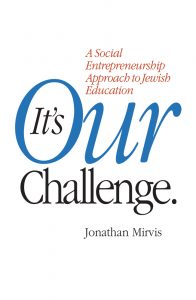
In this highly engaging, instructive and even inspirational inquiry, Jonathan Mirvis illuminates the tapestry of Jewish education innovation with the lens of the work and theory of social entrepreneurship. He tells us how and why some Jewish educational innovators succeed and how to recognize the most promising ventures in the field. This work will appeal to anyone engaged in Jewish educational change or social entrepreneurship of any kind, as it contributes to our understanding of both worlds of thought – Jewish education and the applied theory of social innovation. Professor Steven M. Cohen Research Professor of Jewish Social Policy, Hebrew Union College-Jewish Institute of Religion
Jonathan Mirvis has written a provocative and invaluable tract for our times, and for the uncertain times ahead. Whether Jewish “peoplehood” will have any meaning for the next generation in Israel and the Diaspora, depends largely on whether Jewish education can re-invent itself. Not only for our children and grand-children, but for “adults” and whole communities as well. Jerry Silverman President/CEO, Jewish Federations of North America
Australia : AUS$ 25.00 Discount price: AUS$16.99 Free delivery
South Africa : Israel: Discount price: £14.99 Free delivery by Courier
The good news is that Mirvis believes it can happen. He shows us how to build on the trailblazing initiatives of some of the visionary Jewish educators and funders who’ve “changed the rules” – and whose stories Mirvis tells with great warmth and insight. And, critically for the author, by adapting his theory of change as it applies to social entrepreneurship marketing, and the online knowledge revolution. This is not just an important book about the need for more “disruptive innovation” in the Jewish world; Mirvis is himself the “disruptive innovator”. He’s brought together his wide experience in adult Jewish education internationally, his deep immersion in Yiddishkeit, and some novel, even radical thinking about – dare we say it – how to market and sell a social product. Ever the teacher, he’s given educators, funders, policy-makers, and community leaders essential homework to complete. Read this book!
Dr. Jonathan Mirvis is a senior lecturer at the Melton Centre for Jewish Education at The Hebrew University of Jerusalem. He specializes in social entrepreneurship, social innovation and adult education. He lectures in these areas to graduate students studying Jewish education, nonprofit management, business administration, and community development.
Reviews...
Jewish Philanthropy.
Dr. Jonathan Mirvis has just released a very exciting book, It’s Our Challenge: A Social Entrepreneurship Approach to Jewish Education. Its most surprising aspect is that it has implications not just for Jewish education providers but also for all Jewish organizations and their professional and volunteer leadership around the globe. Dr. Mirvis, who is a senior lecturer at The Hebrew University’s Melton Centre for Jewish Education , is a pioneer in teaching social entrepreneurship to students in education, nonprofit management and business administration. Although the book gives a spot-on analysis of entrepreneurship in Jewish education, its salient contribution is demonstrating not only the importance of creative and innovative thinking but also the impact that volunteer leaders and professionals can have in the Jewish community by thinking differently about what they do and how they do it.
Following a near-death experience that left her contemplating her past, Karen O’Donnell set out with new determination to be seen and heard. The message?You don’t have to wait until some life-altering event forces you to wake up. The time to wake up is now.Have you ever wondered…Why does life seem to be passing me by?Why don’t I get the success I deserve?Why am I even here?These questions provoked a journey of self-discovery, resulting in a powerful system to explore your own life and experience it as you were meant to live it — with happiness, clarity and success.Discover Your Inner GPS is a simple and effective guide to personal transformation that will help you understand how you can change your life to one you desire and deserve.
Applying the strategies and techniques in this book, you will explore your inner world, uncover the beliefs that keep you on a road you no longer want to walk down and discover your true inner navigationalsystem — the key to staying forever true to you.Not living the life you’re supposed to be living? Discover your inner GPS and find the one that’s out there waiting for you. Even if you don’t yet know where it is... The title is very appropriate as it is a map for inner well-being and development of the self. Karen’s extensive studies in various fields, make her the ideal person to lay out a map for those seeking fulfilment. The book is set out in various steps to be followed and worked at to develop a healthy and holistic lifestyle. Dr. Frank McKenna
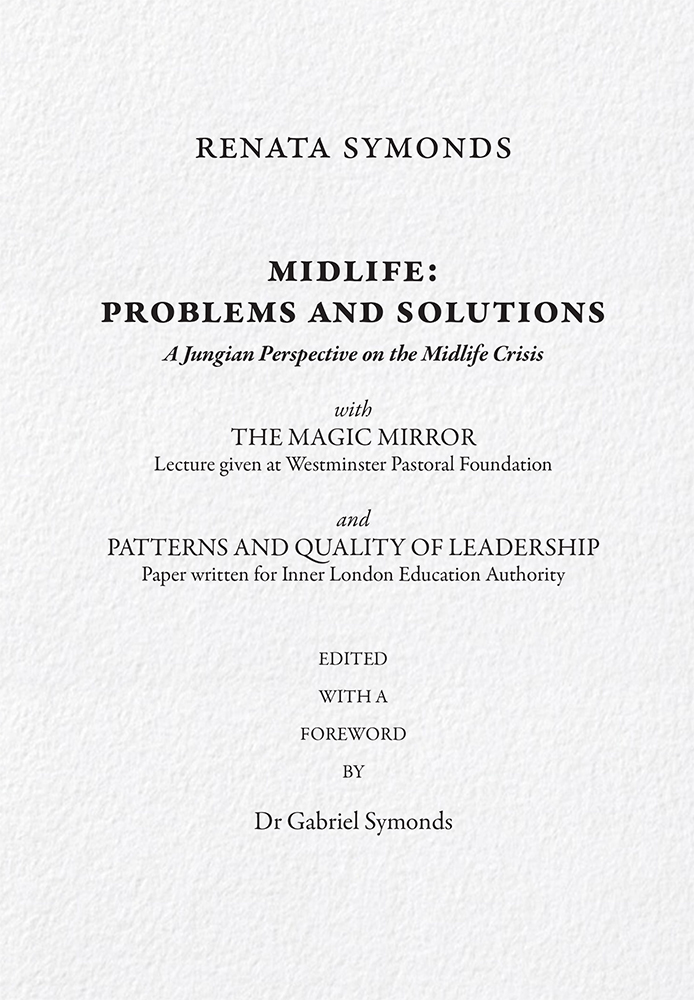
This book is the distillation of the professional wisdom of Renata Symonds (1913 – 2007), a London-based Jungian psychotherapist.
She deals with the perennial problems of humankind that may particularly become evident at the threshold of the second half of life: finding meaning in one’s existence; facing conflicts in work and marriage; dealing with depression, loneliness, and sexuality; and fear of death.
These great themes are explored from the perspective of the writer’s experience in helping people become aware of the unconscious aspects of their problems, especially through dream analysis. Many cases are described of how clients in this way – rather than by resorting to medical drugs to suppress symptoms – make real progress not only in resolving their difficulties but also in achieving inner growth as well.
No dry treatise or self-help book – how to recognise if you’re going through a midlife crisis and what to do about it – Renata Symonds speaks with warmth and enthusiasm of her approach to her clients’ difficulties. The text is enriched by references to Jung and Freud and contains many literary and mythological allusions.
This book will be of interest to the general reader with a basic knowledge of Jung’s ideas, as well as those undergoing or contemplating psychotherapy.
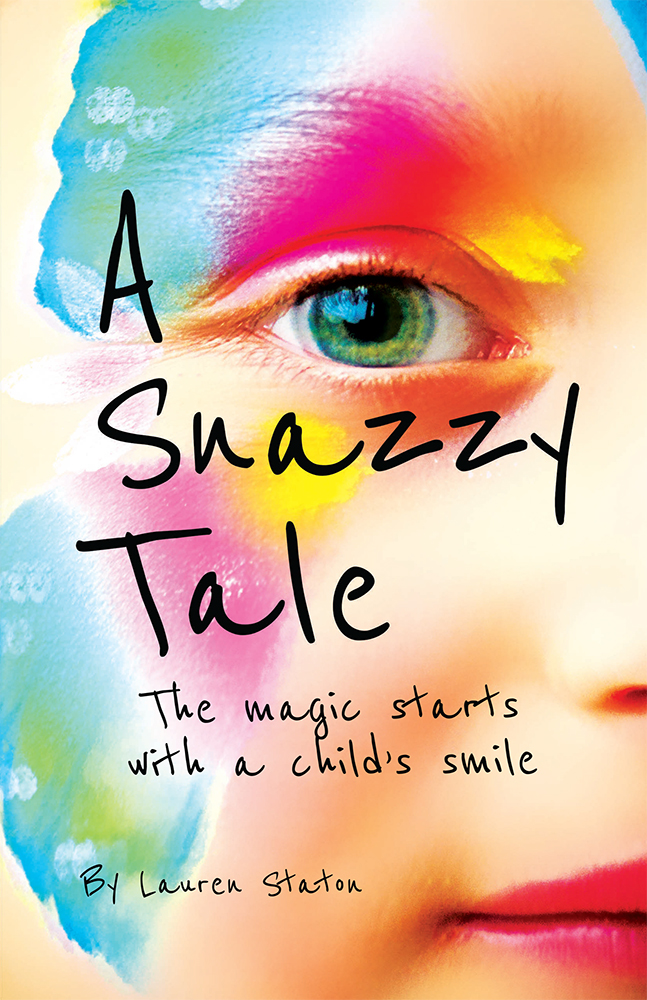
Face painting is a wonderful creative activity which has bought a lot of joy to children, delighted parents, and raised millions of funds for charities all over the world.
This activity became popular in a very short space of time.
This is the fascinating tale of the journey that lead to the creation of the first strong brand of children’s face paints, starting from a small kiosk at a holiday centre in 1985 and eventually reaching a global market.
Lauren and Paul Staton were responsible for bringing face-painting products onto the high street and teaching thousands of people about face painting as an entertainment for children.
The true journey started years before however.
This is an inspirational story of success that grew from passion and from the personal tragedy that fuelled Lauren and Paul's determination.
It will teach you that if you have faith in what you want to achieve, you can truly make magic and make-believe happen.
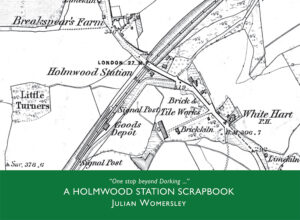
Like all good scrapbooks, this is a serendipitous collection of snippets from the past: photographs, press cuttings and other ephemera are brought together to tell the saga of Holmwood railway station and its role in the social history of a developing community in deepest rural Surrey.
Holmwood station has witnessed astonishing events since it first opened in 1867.
Extraordinary people have trodden its platforms – ranging from a Royal Prince about to be proclaimed King to pauper children sent from a London workhouse. Others included a Crimean War hero; self-made millionaires; gallant officers returning from the Boer War and, during the Great War, wounded officers delivered by ambulance trains. Even the German Kaiser, His Imperial Highness, Emperor Wilhelm II, once alighted at Holmwood.
Special trains came and went - bringing London society people to glittering parties in the country; taking outings to the seaside and visitors to the Crystal Palace or transporting troops to military manoeuvres on Holmwood Common. Suffragettes frequently used the station, as did the Surrey Union Hunt, who unloaded hounds and horses directly onto the platform.
Although aimed at the general reader, the fresh research and new material in this book will appeal to those with more specialist railway or historical interests.
Reader Reviews...
Chris Hewitt
A Holmwood Station Scrapbook is a multi-faceted gem which has been lovingly polished by its author, Julian Womersley, and sparkles with wit and wisdom. At its simplest level this is the saga of a railway station, but don’t be misled into thinking it’s a book for trainspotters; all human life is played out in these pages. There are tales of tragedy, triumph, paupers, politicians and parties which have been painstakingly collected from photographs, archive documents, press cuttings and other material and brought together in one delightful and thoroughly entertaining book. It’s an enchanting read and one I’d highly recommend.
“We love the book and it has also been very well received by our neighbours to whom I gave a copy. Charles commutes from Holmwood and is very intrigued.”
“A fascinating collection of information - it will take hours of study to absorb it. I have found that once opened, it is difficult to put down!”
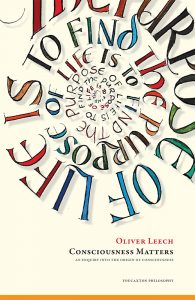
Consciousness Matters addresses the age-old problem of the relationship between consciousness and the material world. In the course of exploring some of the history of this major philosophical subject it looks at a range of materialist responses, such as mind-brain identity theory, behaviourism, functionalism and supervenience, as explanations for consciousness.
Set against these positions is the view, first, that consciousness is neither material nor reducible to material and, second, that consciousness is a prerequisite for our knowledge of the material world. If the latter view is the case, the terms of the debate are shifted fundamentally.
The theories of idealism and dualism of the material and the conscious are considered.
In contrast to the dualism made famous by Descartes, according to which there is two-way causal interaction, the long-neglected theory of occasionalism is introduced and explained with reference to two significant philosophers associated with it. A case is made for a revival of occasionalism that takes into account a more modern perspective. The book ends with an acknowledgement that it has only scratched the surface of this vast and very challenging topic.
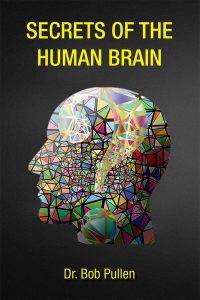
Dr Bob Pullen shines a spotlight on the human brain, which is so central to what we humans are. He explains how our brains are made up of nerve cells or neurons, which behave rather like batteries producing a small voltage which becomes the language of the nervous system, a bit like Morse code. Our neurons can also behave like computer-chips processing electronic data. He looks at the brains of other animals and explains how different parts of the human brain perform different tasks, some areas performing movement, others giving us our five senses. He describes the fascinating ways our brains can create visual illusions, how we produce language and speech, how we feel pain and what happens when we sleep and dream. The book also touches on the nature of consciousness itself.
The book looks at the physical division of the brain into left and right cerebral hemispheres and describes how these differ between men and women.
And what happens when the brain goes wrong; how can it be examined? A damaged brain can cause difficulties, illness and disorder. Remarkable modern methods of examination such as measuring brain waves and magnetic resonance imaging are simply and clearly explained.
The brain is more than a normal organ. It governs how we think and makes us self-aware. Bob Pullen considers the mind, life and death, as well as our place in the universe.
Long-term monitoring of vegetation on Zalidovskie Luga meadow situated alongside the Ugra river in Kaluga Oblast, Russia, has been carried out from 1965 to 2012. Since 1997 the meadow has been part of the “Ugra” National Park, which was assigned the status of a UNESCO biosphere reserve in 2002. During the forty-eight years of monitoring, annual surveys on permanent plots were combined with surveys of haystack locations and adjacent control plots, with detailed observations of populations of particular plant species. A large amount of data has been collated allowing the impact of environmental factors to be assessed.
Over the observation period, agricultural management altered more than once, ranging from single hay cut, hay cut followed by aftermath grazing, double hay cut, extensive grazing, and no management at all in recent years. The data illustrate the reaction of plant communities to these changes. The appendix contains data from 504 relevés recorded on twenty-two permanent observation plots over forty-eight years.
This book will be of interest of vegetation ecologists, conservationists and anyone involved in the management of European floodplain meadows.
When you have produced the final draft of your book, it is always advisable to have the text read and checked by a professional editor or proof reader.
You may have friends that are willing and competent to do this and we can advise you on the type of editing that is required.
We can offer four levels of editing as well as proof-reading.
You choose which, if any, are appropriate in your case: 1. Edit of sample pages and short report (£30)
We will edit a few pages to highlight editorial issues so that you can look for similar problems throughout the book.
This will reduce the amount of further copy-editing required when the book is finished. 2. Broad structural editing and criticism (£5 per thousand words)
A structural review is particularly relevant for works of fiction.
The structural reviewer will address the following main areas and produce a short report for the author ” Read More 3. Copy editing (£10 per thousand words)
A copy-editor takes a close look at your text, line by line, with an eye to grammatical errors, repetition, inconsistency and lack of clarity. The copy editor will make changes to the text, with suggestions for rewriting, grammar, and punctuation. When you receive the edited version, you have the final choice about accepting of rejecting the individual changes. 4. Proof Reading (£8 per thousand words)
Proof reading is a line-by-line check that the book is ready for publication. Proof readers will make small corrections for punctuation, grammar and spelling but they will not make significant changes to the text.
A proof reader will identify any significant issues and add comments to the text so that you can make those corrections yourself. 5. Consistency Scan
If you decide your book doesn’t need a full proof reading, we offer an electronic scan to search for common errors and inconsistencies. This looks at issues such as inconsistent spelling and inconsistencies of hyphenation and capitalisation.
We can also identify inconsistencies in the spelling of proper names. 6. Cover text
The quality of the text on the cover is very important as it indicates the quality of the writing in the book.
The title, sub-title and back-cover blurb are all important elements and we can work with you to make sure that these are correct and effective.
Copy Edit
Copy-editors get the raw material into shape for publication i.e they edit the copy.
When they have finished, the designer can lay out or typeset the book and produce a proof.
It is quite normal for the author to make additional changes after a book has been copy-edited.
Working through the material, the copy-editor may identify errors in spelling, punctuation, grammar, style and usage, but also very long sentences and overuse of italic, bold, capitals and exclamation marks.
They should correct or query doubtful facts, weak arguments, plot holes and gaps in numbering.
In fiction, they should also check that characters haven’t changed their name or hair colour, look for sudden changes from first to third person among other things.
The Copy-editor is not a proof reader and should not be expected to find all of the errors in the text particularly if the text is badly written to start with.
This is the job of the proof reader.
The final proof should be checked by a proof reader or an experienced reader friend before going to print.
It is almost inevitable (and acceptable) to miss a few errors which can be corrected in a later edition.
Proof Reading
Proof reading is a line-by-line check that the book is ready for publication.
Proof readers will make small corrections for punctuation, grammar and spelling but they will not make significant changes to the text.
A proof reader will identify any significant issues and add comments to the text so that you can make those corrections yourself.
If you have decided to complete this stage of the process yourself, we will send a detailed check-list to help you.
We ask you to try and ensure that the book is completely ready before we start the layout.
Once the layout has started, we expect that you might want to to make a small number of amendments but
if there are a significant number, we may need to charge for the extra time it takes to change the layout
so best to discuss this with us first.
Structural Review
In fiction, the main areas that a structural editor will address are:
Plot: Does the plot make sense? Is it believable? Is it satisfying or does it leave the reader frustrated? Themes: Are the themes effectively handled? Are there so many that the book lacks focus? Do they interfere with the plot or complement it?
Characterisation: Are your characters well developed and believable? Are they cast in a role that fits their personality? Do they sometimes behave out of character? Point of view/voice: Is the voice consistent or is it sometimes confused? Is the voice authentic? Are you using too many or too few POVs? Pace: Does the plot move forward at an appropriate pace? Should you cut that preface? Should the action happen sooner or should the tension build more slowly? Dialogue: Do your characters sound real when they speak? Is your dialogue cluttered with adverbs and beats? Do you use clunky dialogue to move the plot forward? Flow: Is the narrative interrupted by dead-ends and tangents? Is there so much back story that the main plot is dwarfed? Are there missing plot points that would give the narrative greater integrity?
In non-fiction, the principle is the same, but the specific issues are slightly different:
Thesis: Is your thesis relevant? Is it clearly defined or is it lost among marginal issues? Exposition: Are your arguments clear and cogent? Are they well researched and properly supported? Do they have a clear relationship with your thesis? Content: Are all the necessary topics sufficiently dealt with? Are the chapters weighted correctly? Is there superfluous content? Organisation: Is the information organised logically? Are tables and illustrations used appropriately? How many levels of subheads do you need and how should they be arranged? Tone: Is the tone appropriate for the audience? Do you need to eliminate jargon? Is the text accessible? Pace: Are there passages that are bogged down in detail? Do you spend too long on detail irrelevant to the main thesis? Are there areas that need further exposition lest they be skipped over?
Cover Text
The quality of the text on the cover is very important as it indicates the quality of the writing in the book.
The title, sub-title and back-cover blurb are all important elements and we work with you to make sure that these are as effective as possible.
Consistency check
If you decide your book doesn’t need a full proof reading, we can run an electronic scan to search for common errors and inconsistencies.
This looks at issues such as inconsistent spelling, hyphenation and capitalisation.
It also checks for consistent formatting of numbers and dates as well as undefined abbreviations.
Full Script Edit
The script that you deliver to us will probably constitute what the industry would classify as the ‘Initial Rough Draft’, i.e. a full screenplay written without any other professional input or advice, and probably without a great deal of rewriting. We work through your draft, line by line, scene by scene, and come back to you with a comprehensive set of notes from which you can then work towards the official ‘1st Draft’. Some of our notes will be broad and general, dealing with such areas as the overall shape and structure, pacing, plot and character development; others will be far more specific, with corrections, clarifications and suggested cuts etc. It is of course entirely up to you whether or not to take these suggestions on board, and to what extent.
Subsequent Script Edit
It is very normal and generally beneficial for the script-editing process to go through at least a couple of cycles
i.e. the rewritten draft to be worked through once again by an experienced script practitioner – though this would be entirely at the discretion and behest of the writer.
Ongoing Support
We aim to make your self-publishing venture an enjoyable and rewarding experience.
Publishing is a complex business and we treat every book as a separate project.
We explain all of the stages at the outset and we manage the project schedule for you. This will include all of the expert services you have requested for editorial, design, printing, distribution and collection of royalties, keeping in close contact with you throughout the process.
You will be allocated a project-sheet on the YouCaxton website so that you can monitor progress and ensure that all stages are properly completed.
If you would like to see an example of a Project-Sheet…
go to My project on the menu and enter…
Username: Sample
Password : welcome.